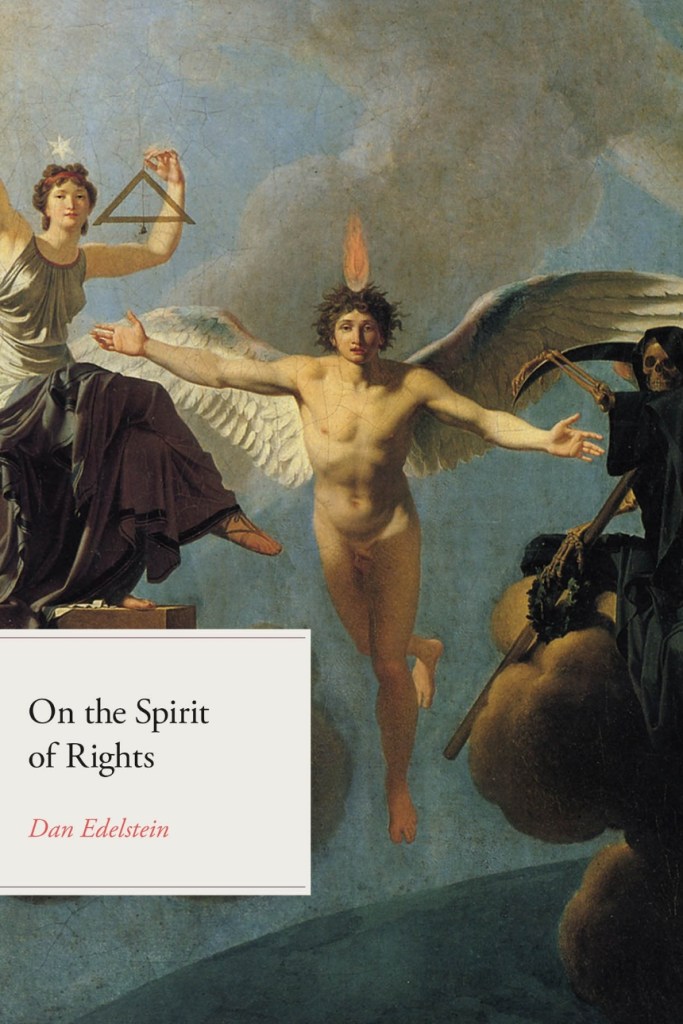
I’ve been reading Dan Edelstein’s On the Sprit of Rights. The history of ideas isn’t really ‘my thing’ but I found some parts of this book quite intriguing. Edelstein’s focus is on the origins of the modern concept of Human Rights, and the book discusses the philoophical and intellectual origins of the concept of rights and the divisions between ideas of individual rights and collective rights. Edelstein distinguishes between French, British and Anglo-American concepts of rights.
In his Second Treatise on Government John Locke had claimed that the labour of men gave them a claim to property. Locke sought to show how men had any rights to land, which in a state of nature was free for anyone to use. Locke sought to demonstrate how if ‘God gave the world to Adam and his posterity in Common… any man but one universal monarch should have any property.’[i] Locke argued that it was labour that gave men a right to property. He pointed to apples and acorns in a wood, which while on the tree belonged to anyone, but once picked they belonged to the person who had picked them. ‘His labour hath taken it out of the hands of nature, where it was common, and belonged equally to all her children, and hath thereby appropriated it to himself.’[ii] Locke may have specifically sought to nullify Native American claims to land as he had himself been involved in the colonisation of the Carolinas and indeed, he specifically mentioned Native Americans in his argument. ‘This law of reason makes the deer that Indian’s who hath killed it; it is allowed to be his goods, who hath bestowed his labour upon it, though before it was the common right of every one. And amongst those who are counted the civilized part of mankind, who have made and multiplied positive laws to determine property, this original law of nature, for the beginning of property, in what was before common, still takes place; and by virtue thereof, what fish any one catches in the ocean, that great and still remaining common of mankind… is by the labour that removes it out of that common state nature left it in, made his property.’[iii] Locke concluded that ‘cultivating the earth, and having dominion, we see are joined together. The one gave title to the other. So that God, by commanding to subdue, gave authority so far to appropriate: and the condition of human life, which requires labour and materials to work on, necessarily introduces private possessions.’[iv] Ultimately, ‘it is plain, that property… too is acquired as the former/ As much land as a man tills, plants, improves, cultivates, and can use the produce of, so much is his property.’[v]
What struck me so strongly, was how much those rights echoed the rights claimed by early frontier colonists. Joseph Dodridge in his reminiscences on the frontier of early West Virginia wrote the colonists believed that ‘building a cabin and raising a crop of grain, however small, of any kind, entitled the occupant to four hundred acres of land, and a preemption right to one thousand acres more adjoining.” He explained that “there was, at an early period of our settlements, an inferior kind of land title denominated a tomahawk right, which was made by deadening a few trees near the head of a spring, and marking the bark of some one or more of them with the initials of the name of the person who made the improvement. For a long time many of them bore the names of those who made them. I have no knowledge of the efficacy of the tomahawk improvement, or whether it conferred any right whatever, unless followed by an actual settlement. These rights, however, were often bought and sold. Those who wished to make settlement on their favorite tracts of land bought up the tomahawk improvements rather than enter into quarrels with those who had made them.”[vi]
[i] John Locke, An Essay Concerning the True Original Extent and End of Civil Government, (Dublin: George Bonham, 1798). p.25
[ii] John Locke, Of Civil Government p.28
[iii] John Locke, Of Civil Government p.28
[iv] John Locke, Of Civil Government p.32
[v] John Locke, Of Civil Government p.30
[vi] Joseph Doddridge, Notes, on the Settlement and Indian Wars, of the Western Parts of Virginia & Pennsylvania, From the Year 1763 until the Year 1783 Inclusive (Wellsburgh: Office of the Gazette, 1824). 99-100.
 Early American Musings
Leave a comment