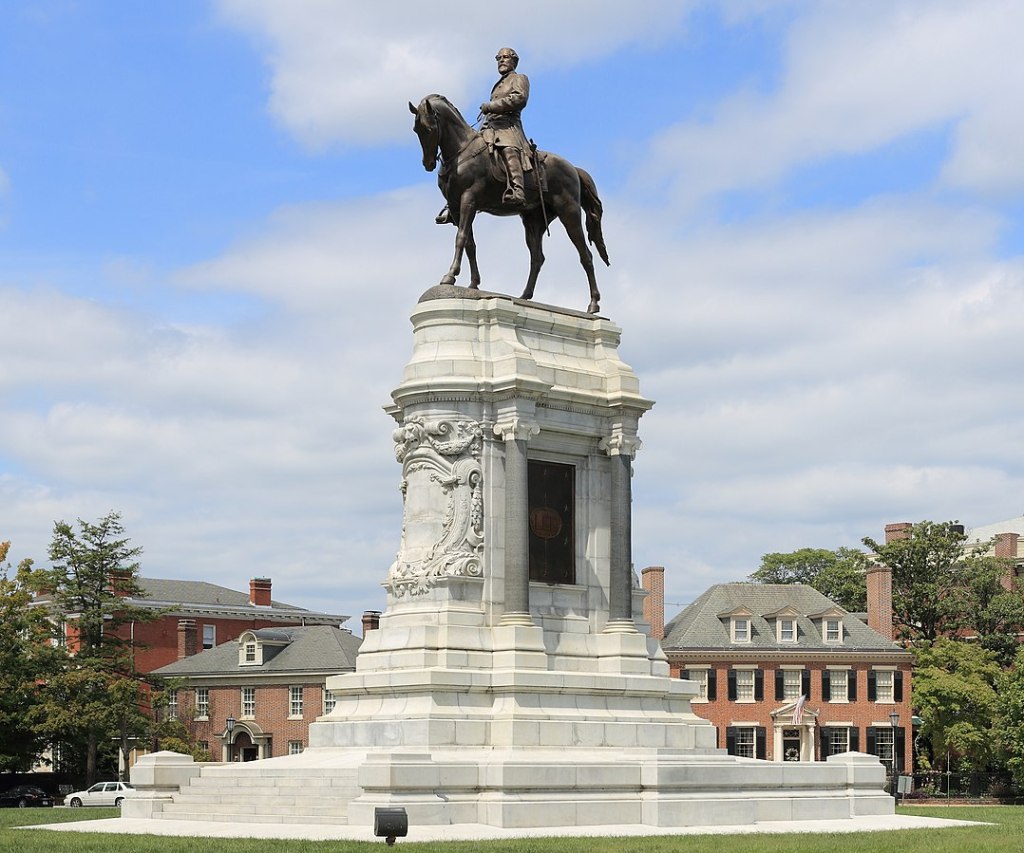
As we drove from Williamsburg to Charlottesville, the sight of Monument Avenue in Richmond stirred a mix of curiosity and reflection. I was eager to see the transformation of the colossal Confederate Memorials that once graced the boulevard. Reflecting on my time in Virginia in the 1980s, I recall being captivated by Monument Avenue’s ‘quaint’ and ‘southern’ charm. However, as a white male, I now realize that I didn’t delve deep enough into the true symbolism of these memorials.
Richmond, the former capital of the Confederacy, was eager to reassert a cultural identity in the wake of defeat and Reconstruction. In 1890, the city unveiled its first—and arguably most controversial—monument: a towering equestrian statue of General Robert E. Lee. On its pedestal, the statue towered over 60 feet above the ground. And the symbolism was significant, Lee was mounted, signifying in part mastery, the mastery of the horse and the dominance of the man.
The placement of these monuments was not arbitrary. Monument Avenue, at the time of their construction, was more of a vision than a neighbourhood. However, as the Lee statue ascended, so did property values, and the area swiftly evolved into an upscale enclave for Richmond’s white elite. These monuments were not just memorials; they were strategic real estate investments cloaked in bronze.
Lee’s statue begat more. Over the next few decades, the avenue welcomed General J.E.B. Stuart (1907), President Jefferson Davis (1907), General Thomas ‘Stonewall’ Jackson (1919), and Confederate naval hero Matthew Fontaine Maury (1929). The Monument Avenue Commission, a civic body with deep links to Confederate heritage groups like the United Daughters of the Confederacy (UDC), played a central role in commissioning these works, crafting a carefully curated historical narrative.
Richmond was, in many ways, a microcosm of many southern towns. Most of the Confederate memorials were not erected in the wake of the Civil War, and the memorials were generally rather plain and consisted of weeping angels or wounded soldiers. Most of the contentious memorials were erected between 1890 and 1920. These were the years in which the southern states were busy developing and enforcing Jim Crow segregation laws, in the wake of the 1896 Supreme Court ruling Plessy vs Ferguson, which allowed for the segregation of public facilities under the mantra ‘separate but equal.’ Of course, they were rarely equal.
The Southern Poverty Law Center has a good chart showing when these memorials were constructed.
The construction of these monuments reflected a renewed Southern pride decades after the end of the Civil War. They were an expression of white supremacy and reflected the reemergence of the KKK. The monuments were as grandiose in symbolism as they were in scale. Jackson’s statue depicted him looking almost like a biblical prophet, hand raised as if blessing his troops—or possibly hailing a cab. Jefferson Davis stood with an outstretched arm in front of a neoclassical colonnade as if eternally giving a speech that most of Richmond wished he’d shorten.
For decades, Monument Avenue stood largely unchallenged, serving as the aesthetic backbone of a city that fancied itself genteel. But beneath its magnolia-scented charm, the avenue’s monuments were contentious. They symbolized a whitewashed version of history, the history of the ‘lost cause, where slavery was a footnote, and Confederate leaders were virtuous heroes defending their homes and families rather than an insidious institution.
It wasn’t until the Civil Rights era that real cracks began to show. Richmond’s Black community increasingly called attention to the monuments’ role in perpetuating racial hierarchy. In 1996, the city installed a statue of African American tennis legend Arthur Ashe—a native of Richmond and the first Black player to win Wimbledon—at the western edge of Monument Avenue. Ashe’s inclusion, while celebrated by many, also triggered an avalanche of thinly veiled panic among certain circles. One anonymous donor allegedly offered to pay for Ashe to be placed ‘elsewhere,’ so as not to disrupt the Confederate’ theme.’ The city declined. But for me, Ashe’s statue, which is the only one that remains, also served in many ways to underline the theme of white supremacy. You had numerous towering statues of white military heroes and a tennis player.
Ashe’s statue introduced a new energy—monumental, but with a wry sense of timing. During the dedication, a child in the crowd was overheard asking why Ashe was holding a book. “So he can read all the angry letters,” his dad quipped.
The murder of George Floyd in 2020 sparked worldwide protests and the rise of the Black Lives Matter movement. The monuments on Monument Avenue became literal battlegrounds. Protesters tagged them with graffiti, wrapped them in ropes, and reimagined them with artful subversion—Lee was briefly adorned with a pink unicorn horn and face mask. (The statue of the Duke of Wellington in George Square, Glasgow, is nearly always famously adorned with a traffic cone, but not as a symbol of protest.)
Richmond Mayor Levar Stoney ordered the city-owned statues taken down in July 2020, citing public safety and moral urgency. Jackson, Stuart, Davis, and Maury were all removed within weeks. The Lee statue, however, proved trickier. It stood on state land and was protected by arcane laws, including a 19th-century covenant stipulating the statue must remain in perpetuity.
In a dramatic legal saga, the Virginia Supreme Court ruled in 2021 that the state could indeed remove the statue, effectively breaking the “forever” clause. In September of that year, Lee was finally brought down in front of a massive crowd, many of whom cheered as if at a New Year’s countdown. For some, it was catharsis. For others, it was sacrilege.
The statues themselves are now in storage, and their future is uncertain. Some advocate for display in museums with full historical context; others would prefer they remain buried in archives, consigned to memory. On the avenue itself, the roundabouts where they once stood have now been paved over or contain manicured flower beds. There is little sign that for over a century, they had contained such contentious memorials.
We stopped at a lovely little coffee shop off the end of the avenue and chatted with some of the people there—who, as everywhere, thought two Scotsmen on a road trip across America was a great thing! They were relieved that the monuments were gone, not just because of what they symbolised, but also because of the sorts of people they sometimes attracted.
 Early American Musings
Leave a comment