From Philadelphia, we headed on down to Jamestown and Williamsburg. I completed my PhD at William & Mary in Williamsburg and even worked as an interpreter for a summer at Colonial Williamsburg, but it had been a long time since I had been back.
I was impressed by the interpretation in the museums in Jamestown, and I wish I could take my students on a visit there! Jamestown was presented not solely as the story of the heroism of English colonists but as a place where three peoples—Native American, African, and English—interacted, and the focus of the museum was very much on these interactions. It was interesting how, with comparatively little left to see, the museum was able to turn quite stuffy archaeological artefacts into a compelling narrative of Early America.
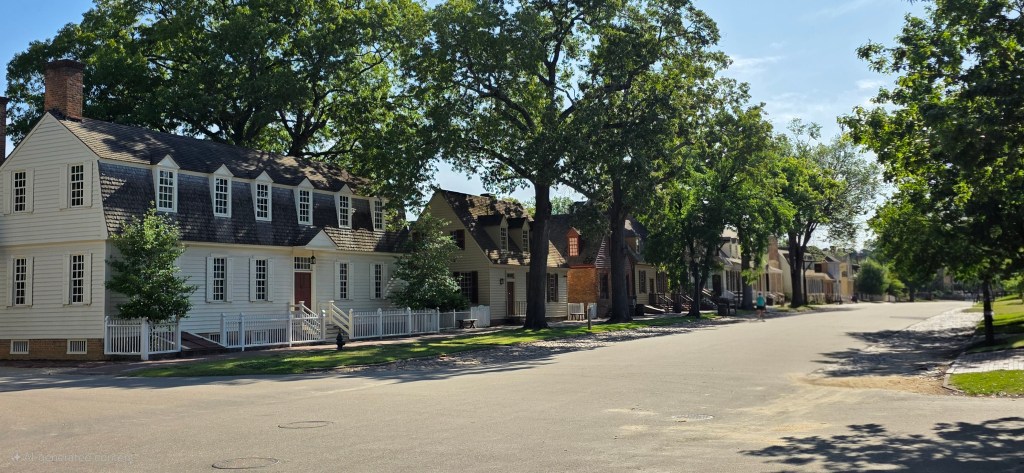
I really liked the way in which Colonial Williamsburg has developed their interpretation in the thirty plus years since I spent a summer working with them. This was no longer the story of a few wealthy white men and their quest for independence from Britain, but a much broader social history about the community as a whole. The evolution of this interpretation, from a narrow focus on wealthy white men to a more inclusive narrative about the entire community, is a significant development in historical interpretation. I think I saw this most clearly in the Peyton Randolph House where the kitchen and domestic quarters have been reconstructed a the back of the house. This allows a discussion of the role that the enslaved domestic and kitchen workers were playing within the household, the role of Peyton Randolph’s wife in managing the household, and only then do you come to a discussion about all the wealthy men who were visiting the house and what they may have been discussing. It has always been this sort of social history that has most interested me: dry political and constitutional history has always been a total turn-off for me, and I thought this worked very well to create a nice picture of the entirety of the community without having to belabour the history of slavery.
I had wanted to visit the reconstruction of the Bray School, where enslaved children were educated. It was not there at all when I lived in Williamsburg, and I had no idea that such a place existed. I don’t think it is true that slavery was ignored thirty years ago, but the experiences of enslaved people were certainly much more marginal and were interpreted more in terms of how they interacted with the white elites who were forging the Revolution. Indeed, interest in how poor people and enslaved individuals lived has grown significantly over the past few years. The existence of the Bray School suggests a society very different from the antebellum South, where teaching an enslaved person to read and write was a crime. Unfortunately, it was closed when we got there, so we were unable to see it.
Williamsburg was much more engaging and inclusive than I remember it thirty years ago. But what struck me very much, at both Jamestown and Colonial Williamsburg was how white and generally middle aged or older, the audience was. There had been coachloads of school children in Philadelphia and people of many different ethnic backgrounds, but Williamsburg seemed full of people rather like me… This change in audience demographics could be due to various factors, including accessibility, cost, and the nature of the historical interpretation. It doesn’t seem to be that expensive; a single day ticket is just over thirty dollars, which I think is almost the same as when I worked there over thirty years ago. Perhaps it is just less accessible than Philadelphia, and of course, many of the sites in Philadelphia are free.
 Early American Musings
Leave a comment