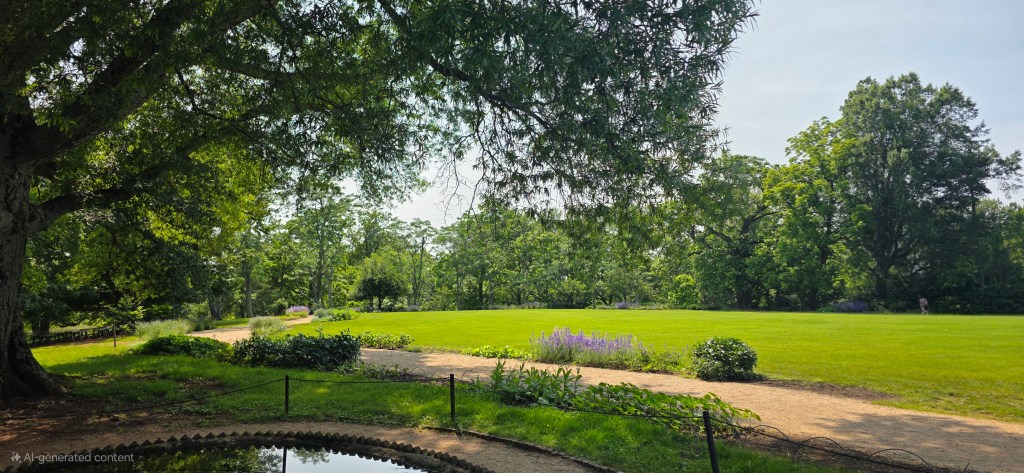
We did a gardens tour at Monticello. The gardens are not that impressive, particularly compared to the gardens at any British country house. But the tour itself was fascinating and said a lot about Jefferson. The guide discussed how Jefferson was interested in discovering what was an American landscape. That really piqued my interest. I’m interested in Crèvecoeur’s question ‘what is this new man, this American’ and in considering how attempts to define American manhood shaped so many different things. But I hadn’t thought of the landscape in a similar way.
Jefferson was interested in trying to uncover an American landscape, and you can see this to some extent in his Notes on the State of Virginia. It also underlay his interest in supporting the Lewis and Clark Expedition. Jefferson instructed Lewis and Clark to collect plant specimens during their 1804–1806 expedition. He wanted to discover new crops that could be cultivated back east, blending botany with national expansion. He was exceptionally interested in the detailed reports of the flora and fauna that Lewis and Clark brought back, and experimented with planting some of the plants and seeds in his garden at Monticello.
Indeed, that seems to have been Jefferson’s approach to an awful lot of his life at Monticello: let’s try it out and see if it works. He seems to have started lots of projects and just abandoned them. He got enslaved labourers to construct an elaborate 1,000-foot-long vegetable garden terrace carved into the mountainside. He meticulously recorded plantings and failures in a “Garden Book,” showcasing his scientific approach to gardening.
He took up gardening quite enthusiastically after his retirement from the presidency and wrote in 1811: “Though an old man, I am but a young gardener.” By this time he preferred talking about vegetables over politics, claiming gardening brought him more peace than the presidency ever did.
 Early American Musings
Leave a comment