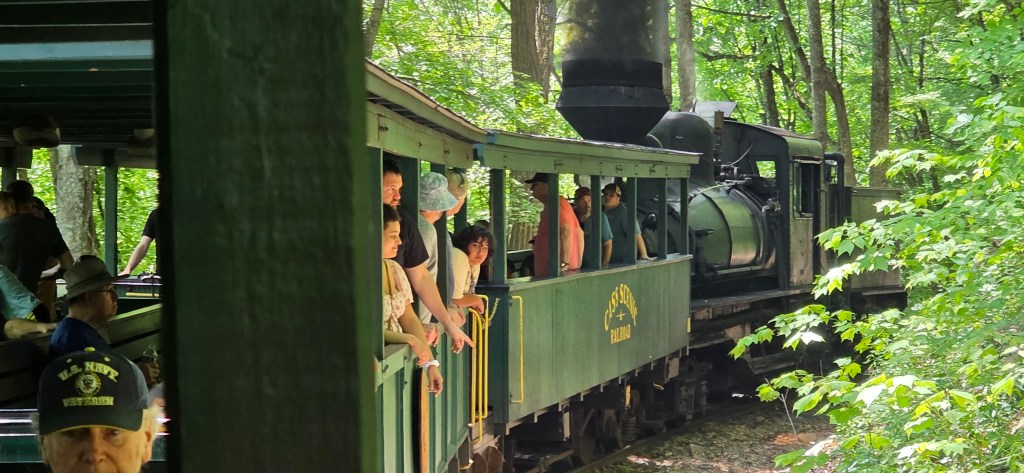
We drove on down into West Virginia and stopped at the Cass Scenic Railroad.
We took the ride to Bald Knob, the third-highest point in West Virginia, which offers breathtaking panoramic views of the surrounding mountains and valleys. It was a four-and-a-half-hour round trip climbing over 2,300 feet, twisting through dense forests. Where there was a gap through the trees, the views were amazing, and the view from the top was spectacular. It was undoubtedly the steepest steam train journey I have ever been on, and, astonishingly, this was not a funicular railway built for passengers to admire the view.
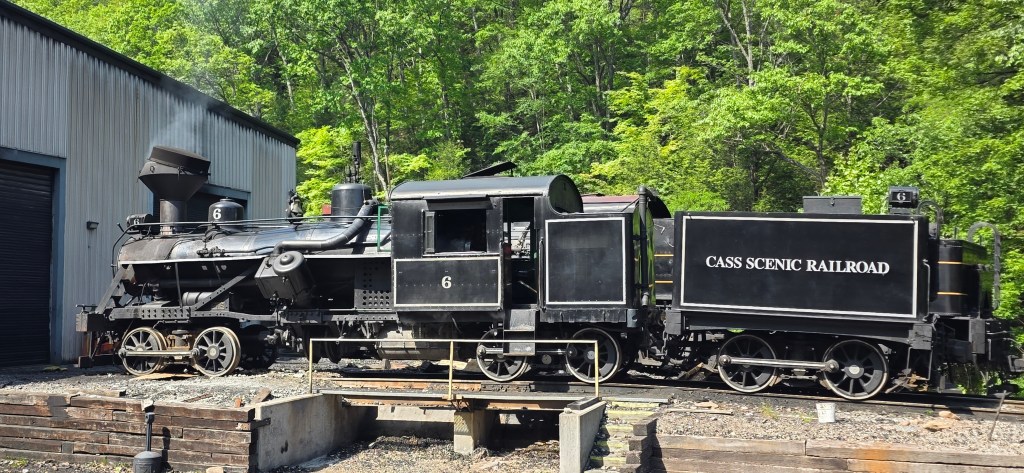
The railroad was constructed to collect lumber for the West Virginia Pulp and Paper Company. I cannot imagine hauling lumber along the line, but the lumber came down, so the engines just had to stop it from running away. Construction began in 1901. The line was specifically designed to haul massive loads of red spruce and hemlock down from the rugged slopes of Back Allegheny Mountain. The engineers used Shay locomotives, specially built to handle steep grades and tight curves. These geared engines weren’t fast—I forgot to take my walk monitor off, and it registered as a walk. We were traveling just over 4 miles per hour on the way up and about 6 miles per hour on the way down—but they were powerful and nearly indestructible.
Cass became a booming company town, where workers lived in uniform company housing and answered to company bosses. Built in the early 20th century by the lumber company, it was designed to keep workers close and compliant. Everything—from houses to churches to the company store—was owned by the bosses. Workers were paid in company scrip, which was only usable in company stores. This led one worker to quip, “You could buy anything you wanted—as long as it was overpriced and moldy.” This type of organisation was typical of many company towns in the early twentieth century.
The town attracted workers from across the eastern United States as well as immigrants from Europe. I tried to find out if my ‘favourite’ trade union, the ‘Wobblies’ or The Industrial Workers of the World (IWW). Known for organizing marginalized and mobile labourers, they attempted to make inroads among the timber workers and rail workers in Appalachia. Although there is no solid documentation that the IWW ever firmly established a foothold in Cass itself, their radical reputation and literature likely influenced worker sentiment. The IWW’s calls for “one big union” resonated with loggers frustrated by exploitative conditions and the company’s tight grip on daily life. However, the company actively suppressed organizing—blacklisting, firing, and even intimidating suspected union men. With few alternatives for employment and entire families dependent on the company, organizing was a risky endeavor.
By the 1960s, the timber was depleted, and Cass was on the brink of becoming a forgotten ghost town. However, the love for vintage railroads saved the day. In 1963, the state of West Virginia transformed the railway into a state park, preserving one of the earliest heritage railroads in the United States.
The locomotives at Cass are not your average steam trains. The Shay engines, resembling steam trains covered in armour, were built for sheer power, not speed. They are the ‘turtles’ of the rail world, but with the strength of a bodybuilder. These engines can conquer an 11% grade, a feat that most trains would struggle with. The slow, rhythmic climb up the mountains was mesmerizing—smoke billowing, gears grinding, and the train shaking. This also had the wonderful effect of putting all the children to sleep. At times, we had to pause for the engine to replenish its water or build up more steam pressure. Engineers at Cass often joke that the train has two speeds: slow and nap time.
Not only was Cass a great experience with wonderful views, but it was also a good reminder of the different roles that railroads played in the development of the United States. I associate railroads with the opening of the West, engines steaming across the Great Plains. However, they were also crucial in opening up areas like West Virginia, enabling the extraction of resources such as coal and lumber. In our travels, we noticed many abandoned lines high up the mountainside. In Scotland, you would certainly not see railways at the tops of mountains.
 Early American Musings
Leave a comment