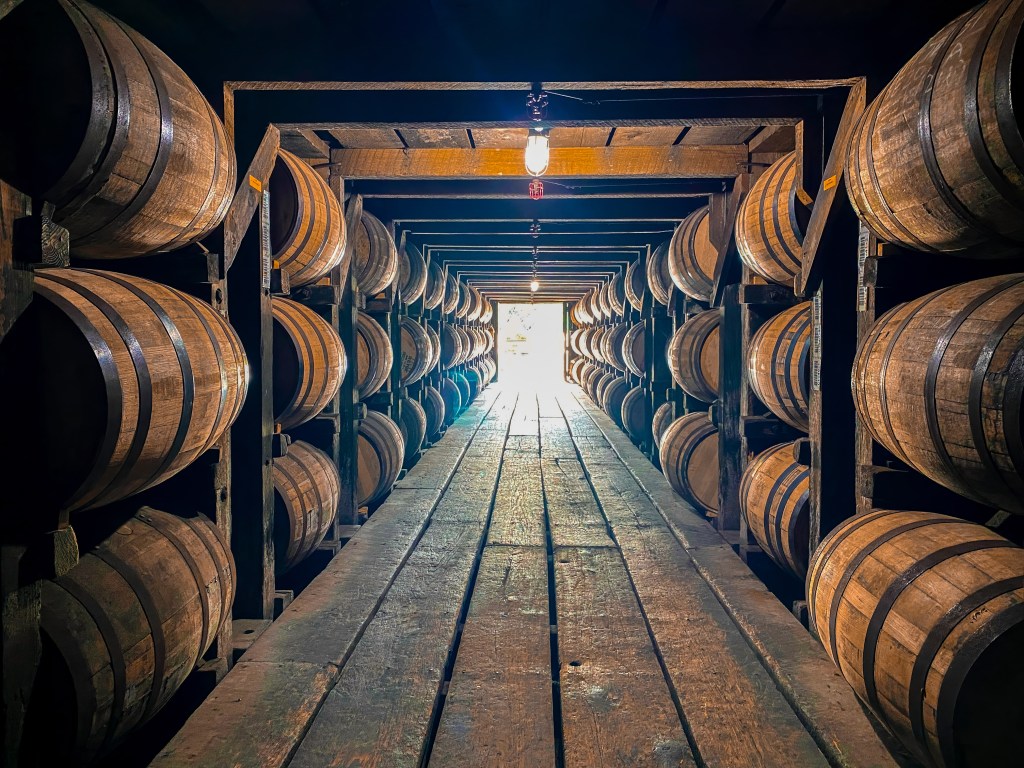
We spent this morning in Louisville shopping for some Kentucky Bourbon. While I confess that I do prefer Scottish Whisky, and that is really my favourite tipple, it is good to taste some local specialities, and Kentucky bourbon can make a nice change. This history of bourbon is also quite interesting. It’s not clear why it is called bourbon, although it may relate to Bourbon County, Kentucky.
The story of whiskey making began in the late 18th century when settlers of Scots-Irish, German, and English descent brought with them the age-old art of distillation. They found Kentucky’s natural resources ideal: fertile cornfields, pristine water filtered through limestone, and vast oak forests perfect for crafting barrels. One enterprising Baptist minister, Elijah Craig—often mythologised (perhaps unjustly) as the “Father of Bourbon”—is said to have aged his whiskey in charred oak barrels. This happy accident birthed bourbon’s signature caramel hue and smoky sweetness.
By the 19th century, bourbon was flowing across the nation, aided by the Ohio and Mississippi rivers. The spirit’s popularity only grew, even surviving the calamity of Prohibition, when many distilleries were forced underground or shuttered—though a few remained legally open for “medicinal purposes” (a loophole eagerly exploited).
After a post-Prohibition slump and the rise of vodka in the mid-20th century, bourbon made a triumphant comeback. Designated “America’s Native Spirit” by Congress in 1964, it enjoys protected status: to be legally called bourbon, it must be made in the U.S., contain at least 51% corn, and must have been aged in new charred oak barrels.
The production of bourbon begins with the mash bill, a blend of grains that must include at least 51% corn (as mandated by U.S. law). This blend is typically rounded out with rye or wheat for added spice or softness, and a touch of malted barley is added to aid fermentation. This grain mix is ground, cooked, and combined with limestone-filtered water—Kentucky’s geological gift to the craft. The resulting mash is cooled, and yeast is added, starting fermentation in massive tanks known as fermenters. The bubbling, frothy result is called “distiller’s beer.”
This beer is then distilled, often in traditional column stills, where the beer is heated and the alcohol rises, separating from impurities. The vapor is condensed back into liquid form, creating a clear, high-proof spirit known as “white dog.” Not yet bourbon, this needs one last touch: that is, time in wood.
That’s where the barrels come in—new, charred American oak vessels that lend bourbon its rich colour and signature flavours of vanilla, caramel, and spice. The spirit is aged for years (by law, at least two; by tradition, often four or more), sleeping in Kentucky’s rickhouses where the seasonal temperature swings coax flavour deep from the wood.
Although they share a lineage and a love for oak-aged complexity, Kentucky bourbon and Scottish malt whisky have taken very different paths over time. At the heart of their difference lies the grain. Kentucky bourbon, by U.S. law, must be made from at least 51% corn—giving it a rounder, sweeter character. In contrast, Scottish single malt whisky is made entirely from malted barley. This results in a drier, often more nuanced flavour profile that is often described as having grassy, nutty, or smoky undertones.
Then there’s the water. Kentucky’s famed limestone-filtered water is low in iron and high in calcium, perfect for distilling and central to bourbon’s clarity and character. Scotland’s water imparts a different minerality and, there is a marked difference between ‘peaty’ malt whiskys such as Laphroaig, and whiskies with pure Highland water such as Glenlivet and Glenmorangie.
The aging process further distinguishes the two. Bourbon must be aged in new, charred American oak barrels, which impart bold flavours of vanilla, caramel, and toasty notes. Scotch whisky, on the other hand, is typically matured in used barrels—often ex-bourbon or sherry casks—which lend more subtle, layered notes. Timeframes also vary: while bourbon can be vibrant at four to six years, Scotch often matures gracefully over a decade or more.
Even the climates shape the spirits. Kentucky’s hot summers and cold winters cause the spirit to expand and contract within the barrel, accelerating aging. Scotland’s more temperate climate encourages a slower, gentler maturation.
Bourbon, or ‘whiskey’ (with an e unlike Scottish whisky) was one of the first major items of production in the early West, and was central to early settlement. It is estimated that almost one in five households in the early West owned their own still, and they would often distil for their neighbours. The other advantage, of course, was that it converted corn into an item that could be easily stored, and relatively easily transported. . It was one of the few items that could be profitably shipped out of the Transapplachian West in the 1780s and 1790s, either over the Appalachian Mountains, or down the Mississippi River. Because there was a desperate shortage of specie (hard currency) in the West it also functioned like currency, and debts were often paid in whiskey. This is one reason why Alexander Hamilton’s Whiskey Excise was so hated in the West: it was seen as an attack on Western lifestyles and the Western economy.
In 1791, under Treasury Secretary Alexander Hamilton’s plans for paying the federal government’s debts, the government imposed an excise tax on distilled spirits. The tax hit hardest in the rural backcountry, especially western Pennsylvania. To small-scale distillers, many of Scots-Irish descent, Hamilton’s tax reeked of the very tyranny they’d fought to escape.
By 1794, resistance boiled over. Tax collectors were tarred and feathered, effigies were burned, and mobs marched under liberty flags. The rebellion reached its peak when over 500 armed men attacked the home of a tax inspector, prompting President George Washington to act decisively. For the first and only time in his presidency, he led a militia force—13,000 strong—into the field. By 1794 he was an old man, and was unable to ride for long periods, so he was transported in a carriage, propped up on several cushions, and then whenever the army approached a settlement he would get out, be helped onto his horse, and ride proudly through the settlement. Once through the town or village, he would hurriedly dismount and get back in his carriage.
The show of force worked. The rebels melted away, and bloodshed was largely avoided. Though only a few men were arrested and eventually pardoned, the message was clear: the federal government had both the will and power to enforce its laws.
While the tax was deeply unpopular and ultimately repealed in 1802, the Whiskey Rebellion marked a turning point. It tested the strength of the Constitution, established the authority of federal law, and foreshadowed the complex relationship between taxation, government, and citizen resistance.
 Early American Musings
Leave a comment