On our way to St. Louis we stopped off at Vincennes. The town is one of the oldest in the Ohio Valley, founded in 1732 by French military officer François-Marie Bissot, Sieur de Vincennes. It was established as a French trading post along the Wabash River, it served as a strategic location for trade and military presence in the region. The city’s early history is marked by its French colonial roots, which have left a lasting impact on its cultural and architectural landscape. The centre of town was a mix of different architectural styles. Standing on the Wabash River is the impressive memorial to George Rogers Clark.
In February 1779, Clark led a daring winter expedition to capture Fort Sackville in Vincennes from British control. He marched his troops across the frozen marshes and creeks of southern Illinois to surprise the fort and forced the surrender of British commander Henry Hamilton (known by the Americans as ‘hairbuyer’ Hamilton because of his purported purchase of scalps from Native American warriors, and his encouragement of warfare against American frontier settlers.) This victory not only secured the western frontier for the American cause but also bolstered morale and expanded the United States’ territorial claims.
It was also significant because, without this victory, the British might have made more of an effort to keep what became the Northwest Territory. One of the things that interests me is why the British surrendered the Northwest to the United States at the Treaty of Paris in 1783. They still occupied all the major posts in the region, such as Detroit, Niagara, and Michilimackinac. They sought a swift and easy peace with the new United States, hoping that by offering generous terms, they would be able to cultivate friendship with the new country and steer the US away from France. Clark’s expedition was also more about capturing the territory for Virginia and securing Virginia’s claims to the West than it was about securing the region for the United States. This was very much a Virginia expedition.
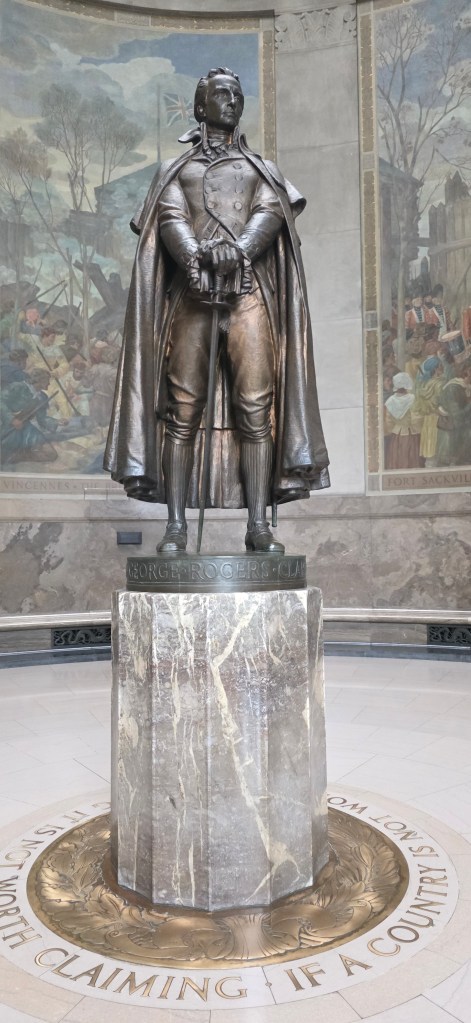
The park’s centrepiece is a magnificent rotunda, between 1931 and 1933. It has a look of one of the later New Deal WPA projects but President Coolidge actually commissioned this. It houses a massive bronze statue of Clark. At the base of the statue is an inscription that says, “If a country is not worth protecting, it is not worth claiming.” I think this reflects a great deal about both the 1770s and the 1930s and the ideas of taking the west. The statue stands at the centre of a circular chamber lined with seven murals by artist Ezra Winter. These massive, colourful paintings depict scenes from Clark’s campaign and the history of the early West. They are typically heroic but imposing and painted with a forced perspective, which makes them stand out even more. The structure itself is built of granite and stands as the largest memorial outside Washington, D.C., dedicated to a Revolutionary War figure.
It certainly was a suprise to see something so grandiose in a small Indiana town.
 Early American Musings
Leave a comment