We visited Cahokia. The site, located about 8 miles northwest of downtown St. Louis, stands as one of the most remarkable pre-Columbian archaeological sites in North America. It was once the epicenter of a powerful Native American civilization, and around the time of the Norman Conquest, it had a population larger than that of London and Paris.
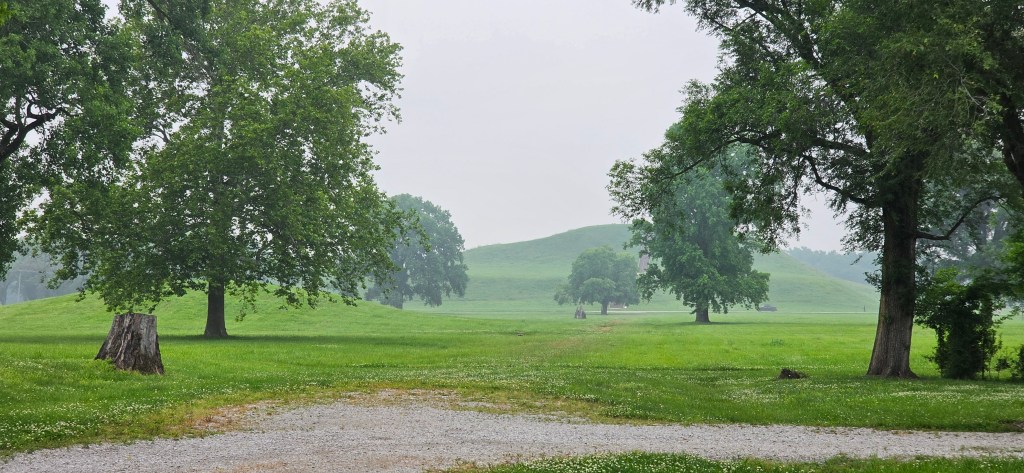
It rose to prominence in the Mississippian period, reaching its peak between 1050 and 1200 CE. Although it was eventually abandoned, the site retains immense archaeological and historical value and has been the subject of significant preservation efforts throughout the 20th century.
By around 1050 CE, Cahokia underwent a dramatic expansion often referred to as the “Big Bang.” Archaeological evidence indicates a significant increase in population and construction activity during this period. The city became the largest urban center north of Mexico, covering approximately six square miles and hosting an estimated 10,000 to 20,000 residents at its peak, with satellite communities potentially boosting the population to 40,000.
The city was meticulously planned, with a central plaza flanked by ceremonial and political structures, including an array of earthen mounds. The most prominent of these, Monks Mound, remains the largest prehistoric earthen structure in the Americas. Standing at 100 feet tall and covering 14 acres, Monks Mound likely served as the base for a temple or the residence of a high-ranking leader, reinforcing Cahokia’s theocratic structure. The level of planning and execution is truly impressive.
Kathleen Duvall’s new book Native Nations: A Millennium in North America has an excellent discussion of the rise and fall of Cahokia and other similar settlements such as Moundsville in Alabama. She shows how around the time that Cahokia was being established, immigrant groups from the Illinois, lower Ohio, and Arkansas river valleys also settled in the area. They formed a densely populated region that featured towns specializing in either intensive farming or the manufacture of specific items. These communities supplied goods to Cahokia’s ruling elite, who redistributed them across the community to strengthen their economic, political, and religious authority. In return, rural producers received protection from external threats.
A significant factor contributing to the decline of Cahokia was climate change. The Medieval Warm Period, which began in the 9th century and had previously enabled farming to expand northward from Mexico, gave way to a colder, more unstable climate. This shift brought prolonged droughts in the late 1100s. The droughts led to both food shortages and an increasing concentration on the production of corn alone, which in turn increased nutritional deficiencies. At the same time, internal social and political tensions were growing. Inequality became more visible as elites built larger homes and acquired more luxurious goods. Evidence of increased conflict, including new defensive walls and a wooden palisade surrounding Cahokia’s central religious and political district, suggests a decline in security. These developments reflected growing social divisions. Eventually, many people left Cahokia for smaller communities, which supported more sustainable economies and greater political inclusion.
Following its abandonment, the site of Cahokia was gradually reclaimed by nature. However, local Native American groups were aware of the mounds and regarded them as sacred. This was recognised by the French, who established a mission on Monk’s Mount in the eighteenth century, which led to the settlement of a small group of local Native Americans returning to live on the mound.
In the nineteenth century, Europeans and Americans could not believe that Native Americans had built the site, and there was much debate about lost peoples or lost groups of European settlers. During the 19th century, the Cahokia site suffered considerable damage due to agricultural practices, urban development, and amateur archaeology. Farmers levelled smaller mounds for cropland, and looters excavated others in search of artifacts. Even Monks Mound suffered from erosion and modification, though its sheer size made it difficult to destroy completely. In the twentieth century, a housing subdivision was built upon the site. We encountered a man who recalled growing up among the mounds in his childhood and playing with the neighbourhood boys, riding their bikes over them. He complained that the state bought out all the residents and bulldozed their homes to protect the site. He now enjoyed walking his dogs there, but felt that the destruction of the community was a big loss.
Cahokia today is an impressive site. It is a UNESCO World Heritage site, but I was very surprised by how quiet the site was. In some ways, this was great, as it allowed you to imagine the site in the distant past. There were even some deer grazing between the mounds when we arrived. This is so different from sites such as Stonehenge, where tourists are carefully marshalled in groups around the site, and it feels almost like a rush hour in London. Perhaps it was quiet because the visitor centre is closed for refurbishment; however, I suspect many people are unaware of or uninterested in the site. This is a great shame, for it is worthy of much more attention. Standing on the top of Monks mound surveying the surrounding site, and taking in the view all the way to the Gateway Arch in St Louis, underlined just how impressive this site really is.
 Early American Musings
Leave a comment