Driving through St Louis we had to stop and visit the Gateway Arch
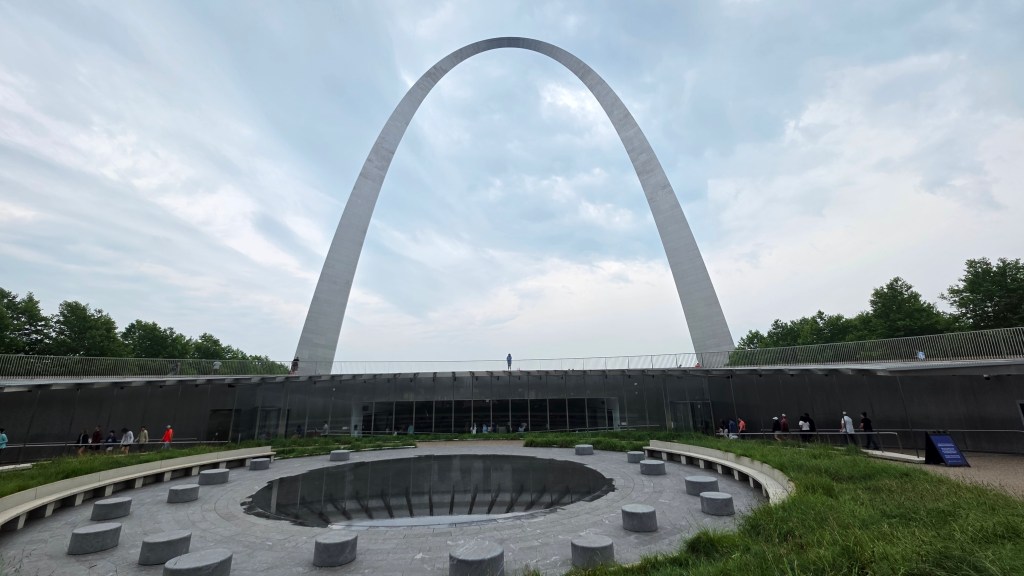
The Gateway Arch was initially called the Jefferson National Expansion Memorial. It was established in 1935 by Executive Order 7253, according to the National Park Service. The park’s name was officially changed to Gateway Arch National Park in 2018 by Congress to better signify its status as a national park and home of the internationally recognized Gateway Arch. The park spans 91 acres and includes not only the Arch itself but also the museum at the Gateway Arch, the historic Old Courthouse (where the pivotal Dred Scott case was first heard), and the grounds surrounding the Arch.
The tram ride to the top is something of an experience. Crammed into a tiny pod, seating five people, for the nearly 4-minute journey to the top, it is difficult not to make some new friends, and it is probably not a good idea if you get claustrophobic. You only get 8 minutes at the top, and the windows are quite small, but everyone gets a chance to see out of the window, and it is definitely worthwhile.
The Arch itself is 630 feet high and is the tallest man-made monument in the United States, surpassing the combined heights of the Washington Monument and the Statue of Liberty. Designed by Finnish-American architect Eero Saarinen, the Gateway Arch was intended to serve as a monument to the United States’ westward expansion. It honours Thomas Jefferson’s vision and the pioneers who followed the call to explore the vast, untamed western territories. The Arch is also a tribute to the city of St. Louis, often referred to as the “Gateway to the West,” due to its historic role as the launching point for expeditions into frontier lands during the 19th century.
After the completion of Clark’s memorial in Vincennes, the citizens of St Louis wanted their own monument in St Louis. Civic leaders in St. Louis wanted a memorial to commemorate the city’s historic role in the westward expansion and to revitalize the waterfront area, which had fallen into disrepair as river traffic declined.
However, due to financial constraints and, later, World War II, the project stalled for decades. It wasn’t until 1947 that the Jefferson National Expansion Memorial design competition was held. Eero Saarinen’s vision won out among 172 submissions. Ironically, the announcement misattributed the win to his father, Eliel Saarinen, a more famous architect at the time.
Construction of the Arch finally began in 1963 and was completed in 1965. It was no easy task—engineers and workers contended with everything from extreme weather to the challenges of precision in building two sides of an arch that had to meet exactly in the middle. If the legs had been off by just 1/64th of an inch, the top piece wouldn’t have fit.
The final section was placed on October 28, 1965, amid considerable fanfare. The Arch was officially dedicated in 1968, three years after its completion.
Today, the Gateway Arch draws more than 2 million visitors annually, making it one of the most-visited monuments in the United States. Its allure is both physical and symbolic. On a practical level, the Arch offers panoramic views from its summit. Visitors can ride to the top in a unique tram system—part elevator, part Ferris wheel pod—that ascends within the hollow legs of the Arch.
The recently renovated museum at the Gateway Arch adds context and depth to the experience. Opened in 2018, it features immersive exhibits on the early history of St. Louis, Native American cultures, westward migration, and the design and construction of the Arch itself. The museum itself was quite a surprise. I thought it could easily have been a congratulatory story of American progress and expansion. Still, while appealing to a popular audience, it was more nuanced in its presentation of the history of Western expansion.
Because you have to pass through the museum to get to the tram ride to the top, and because most people arrive in plenty of time and cannot board the tram until the time on their ticket and need to kill time, the museum has a captive audience, and compared to all the other museums we have visited so far it was bustling.
The museum is divided into six main exhibit areas, each telling a unique part of the story behind the westward expansion and the city’s role in shaping the nation. Colonial St. Louis explores the city’s early days as a French fur trading post, highlighting Native American life, cultural exchanges, and European settlement in the Mississippi River region. The second area, Jefferson’s Vision, focuses on President Thomas Jefferson’s Louisiana Purchase and his bold ambition to expand the United States westward, setting the stage for future exploration and settlement. In the third area, the Riverfront Era, visitors learn about 19th-century St. Louis as a bustling port city. The fourth area, Manifest Destiny, examines the philosophical and political movement that justified westward expansion, as well as the negative impact of this expansion on Native American communities. The fifth area, The Building of the Arch, showcases the design competition and the groundbreaking engineering techniques to construct the Arch. The final section, New Frontiers, links past to present, exploring how westward expansion shaped American identity and what “the frontier” means in modern times.
The museum featured an excellent blend of images and illustrations, particularly in areas such as “Manifest Destiny” and “Jefferson’s Vision.” These help convey the ideological backdrop of expansion and the vast, often romanticised landscapes of the American frontier. Many are original works or reproductions of 19th-century pieces. There are also many historical photographs, particularly of nineteenth-century St. Louis and the construction of the Arch. These images are combined with various original artefacts such as Native American tools and pioneer possessions to construction equipment used on the Arch. There are also reconstructions and dioramas that bring scenes to life, such as a recreated fur trading post or a 19th-century St. Louis street scene.
Overall, I was more excited by the museum than by the Arch. The Arch is an amazing physical monument, but the tram ride to the top and the view are interesting, albeit not particularly exciting—especially since we had visited the World Trade Center in New York just 10 days prior. I wasn’t expecting the museum, and I love this sort of presentation. I thought it gave a good sense of the history of American expansion.
 Early American Musings
Leave a comment