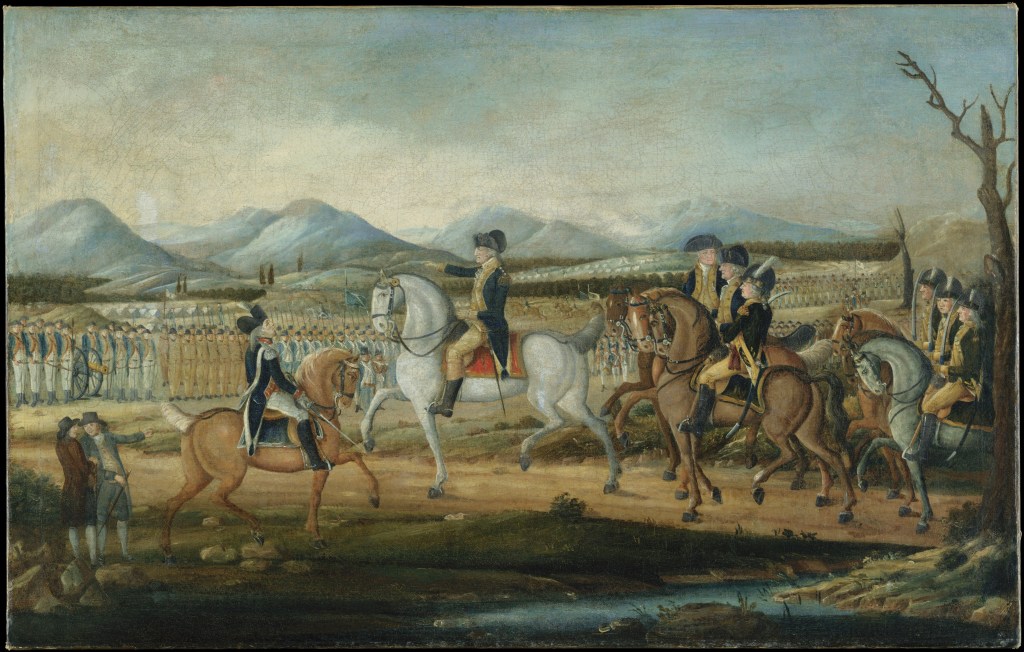
Attributed to Frederick Kemmelmeyer. The Met Fifth Avenue https://www.metmuseum.org/art/collection/search/11302
While having breakfast in Kansas City, everyone was watching the news. The film of the riots in Los Angeles and the National Guard’s use of tear gas was causing some consternation. I was chatting to a couple of people about the news, as we are heading West, but fortunately, not to Los Angeles.
What strikes me very much about the situation is how much it reminds me, in various ways, of the Whiskey Rebellion of 1794. While the broad contexts are very different, in both instances, you have a broad-based protest against government policies that ultimately focused on one specific issue. The Whiskey Rebels were not just protesting the Whiskey Excise; they were protesting how Alexander Hamilton’s policies seemed to be profiting the wealthy elite of the new country. Many of the protests centred on land and the engrossment of land by speculators, and the ways in which the federal and state governments were supporting the activities of land speculators. While the protests in Los Angeles are focussed on the activities of ICE, underlying them, I think is a broader opposition to government policies.
Secondly, the New York Times reporting gives the impression that President Trump ‘is spoiling for a fight on America’s streets.’ Similarly, Alexander Hamilton created the Whiskey Rebellion. Hamilton sought an opportunity for the new federal government to assert its authority and demonstrate its power. Western Pennsylvania was the perfect place. It wasn’t the only place where there was opposition and unrest—that spread across most of the West of the United States. However, it was close to the capital—at that point, still Philadelphia—and was the easiest point to reach.
The state militias—the forerunners of the National Guard—were also used to suppress the rebellion against the wishes of many state politicians. President George Washington, then a relatively frail old man, led the army West, although he did not cross the Appalachians. It was a ragtag collection of troops, derisively called the ‘watermelon army.’
In the end, when the militia reached western Pennsylvania, the protesters dispersed, and there was no fighting. A few people were arrested, but no one was convicted. In many ways, it was all quite an anti-climax. I discuss this extensively in my recent book, Making the Frontier Man. Let’s hope the same holds true of the Western protests today.
 Early American Musings
Leave a comment