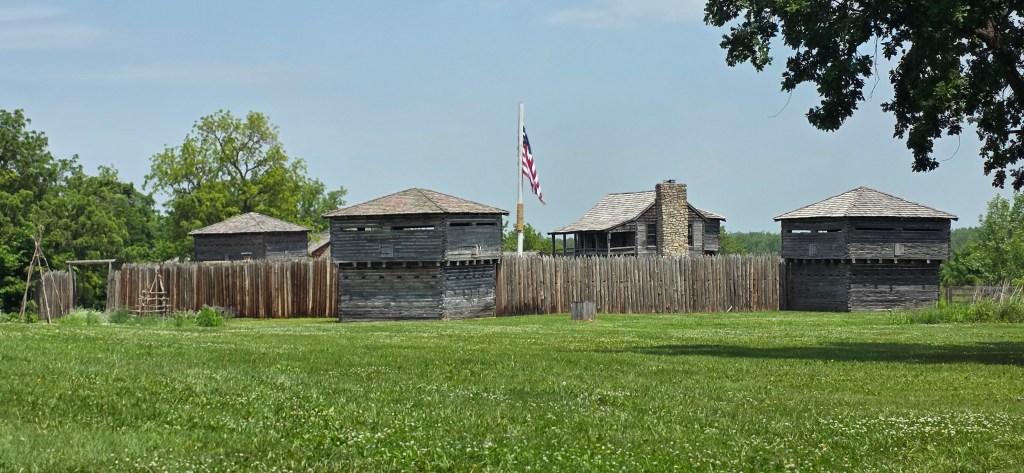
As we neared Kansas City, we decided to detour and visit the restored nineteenth-century Fort Osage. Perched on bluffs overlooking the Missouri River in Jackson County, Missouri, Fort Osage is a reconstruction of the original fort providing a representation of what the site would have looked like in the early 1800s.
It is striking how small the fort is, and clearly it could not have resisted a destermined Native American assault. It was more designed to protect the trade goods within it, than to cow and awe the Osage people. Indeed, for the Osage it would have been a source of American goods, which they would have traded with peoples further north and west and this would have given the Osage great influence in the region.
The fort was established in 1808 under the guidance of William Clark, renowned for his role in the Lewis and Clark Expedition and appointed as the United States agent for Indian affairs in 1807. Following the Louisiana Purchase in 1804, the United States aimed to strengthen its presence in the newly acquired western territories. A key objective was to prevent British traders associated with the Hudson Bay and Northwest companies from operating in the West. To support this strategy, Fort Osage was constructed as a military outpost and trading post. It became one of the first forts built west of the Mississippi River and was intended to be the hub of the American fur trade with the Osage people.
The Osage, with their control over the interior, served as powerful intermediaries between European powers and other Indigenous groups. They dominated key trade routes and successfully repelled incursions from adversaries such as the Comanche and Apache. Their influence was so pronounced that the United States sought to form an alliance with them following the Louisiana Purchase. Fort Osage was strategically established to manage trade in the West and facilitate the flow of goods through the Osage, highlighting their crucial role in the region.
During this period the Osage quickly embraced new technologies, such as firearms and metal tools, while preserving their cultural identity. They upheld their language, oral traditions, and spiritual beliefs, successfully resisting the encroachments of French, Spanish, and American traders and missionaries. Their seasonal migrations for hunting persisted, and traditional social roles and rituals adapted in response to evolving economic and political realities.
Despite their early successes, the Osage were ultimately unable to halt the tide of American expansion, leading to their gradual displacement further south and west. In 1813, against the backdrop of the War of 1812, Fort Osage was temporarily abandoned as U.S. troops were redirected to more urgent conflicts elsewhere. Although the fort saw a brief reoccupation, it was permanently closed by 1822 as trade routes evolved and tensions on the frontier diminished in the region.
The fort serves as a poignant reminder of the ways in which trade and warfare have shaped the region. Both Native peoples and Euro-Americans wielded agency and power. I realise I don’t know as much about the Great Plains as I would like, and over the past year, I’ve dedicated time to increasing my understanding, particularly through reading the works of Kathleen DuVal and Pekka Hämäläinen. It is particularly fascinating to observe that European goods had been integrated into the trade networks of the plains for nearly two centuries prior to American settlement in the region, and how this influenced Indigenous cultures and societies. I am especially intrigued by Hämäläinen’s concept of converging frontiers—specifically, the gun and horse frontiers—and how these dynamics shaped the power and influence of various Indigenous groups as some gained access to horses while others acquired firearms.
 Early American Musings
Leave a comment