As we drove south towards Hastings, we came across a sign ‘Welcome to Doniphan: Preserving “The Good Life.”‘
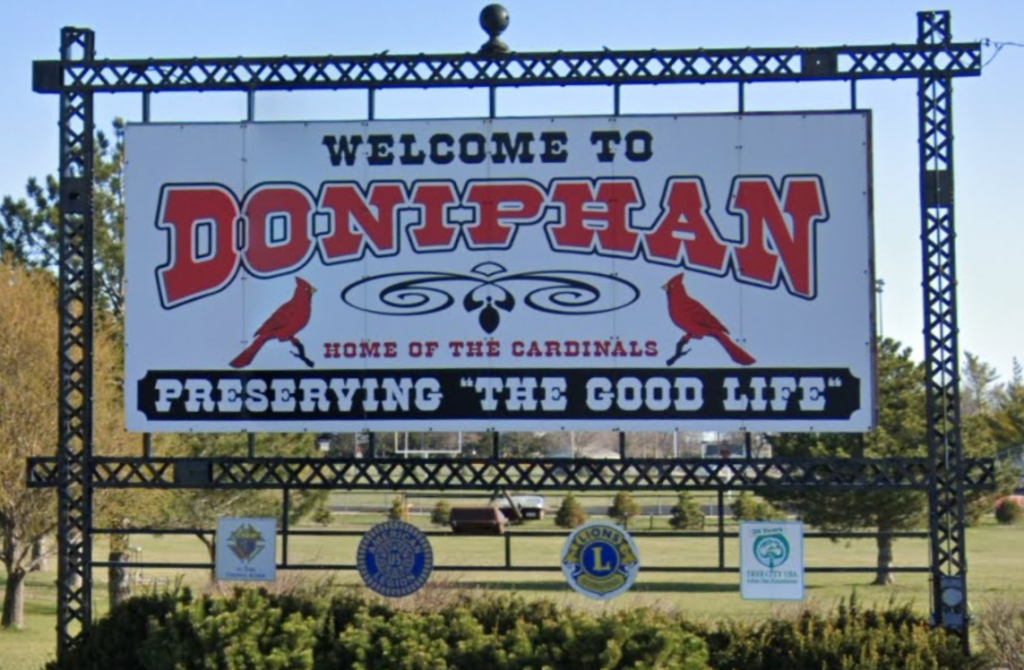
This was a rather strangely phrased sign. I could see a sign saying “where you can live the good life” or “where you can find the good life.” However, preserving the good life suggests that it is somehow under threat. This seemed to typify some of the fears of smalltown Americans about the loss of their identity and culture and the need to “preserve it” from outside threats.
Doniphan, Nebraska, is not just a small village, but a close-knit community located in Hall County, approximately 9 miles north of Hastings and south of Grand Island. As of the 2020 U.S. Census, Doniphan had a population of 809 residents. It is small but not particularly isolated, and it is just off I-80. Politically, Doniphan is situated in Hall County, which has a history of supporting Republican candidates. In the 2020 presidential election, Hall County voted for Donald Trump by a margin of 66.2% to 31.4%, reflecting the conservative leaning of the area.
From West Virginia to Nebraska, many small communities felt like they were being left behind economically. But this didn’t seem to be the case with Doniphan, which felt relatively prosperous. Economically, Doniphan benefits from its proximity to larger towns like Grand Island and Hastings, with populations of 25,000 and 50,000, respectively, which provide access to broader markets and services. The local economy is supported by agriculture, retail, and service industries. Additionally, its location along major transportation routes facilitates commerce and connectivity. The unemployment rate in April 2025 was only 3.2%, so it is relatively prosperous, so why does it feel the ‘good life’ is under threat?
At the Stuhr Museum in Grand Island, just a few miles away, I struck up a conversation with a couple of middle-aged volunteers who were working at the museum and were astonished that two Scotsmen would be interested in visiting the site. We got talking about how different rural Nebraska was from the East Coast. From their comments, it was clear that they were worried that the rural voice was being drowned out in much political debate. They felt that many national policies affecting rural communities, such as environmental regulations, healthcare reform, and economic legislation, are too often shaped by lawmakers from urban districts, particularly those on the East and West coasts. Underlying their comments was a sense of injustice, that they were being governed by people who do not understand the lives and struggles of those who live in small rural communities.
I didn’t push the issues, but I wondered how far this fed into concerns about issues like abortion, same-sex marriage, and the rights of transgender individuals. When our students from Dundee had an online discussion with students from a Nebraska college shortly after the presidential election, the Nebraska students expressed surprise and concern at how these issues seemed to have been so prevalent in many of the local debates, particularly in the local advertising for the election.
It is a little strange that rural Americans have been so warm and welcoming to us. Everywhere we have gone, people have expressed excitement at our trip. Not a single person has been unwelcoming. By comparison, in New York and Philadelphia, people were generally cold and uninterested. I think it is the abstract nature of the ‘other’ that perhaps sometimes provokes fear in small-town America.
 Early American Musings
Leave a comment