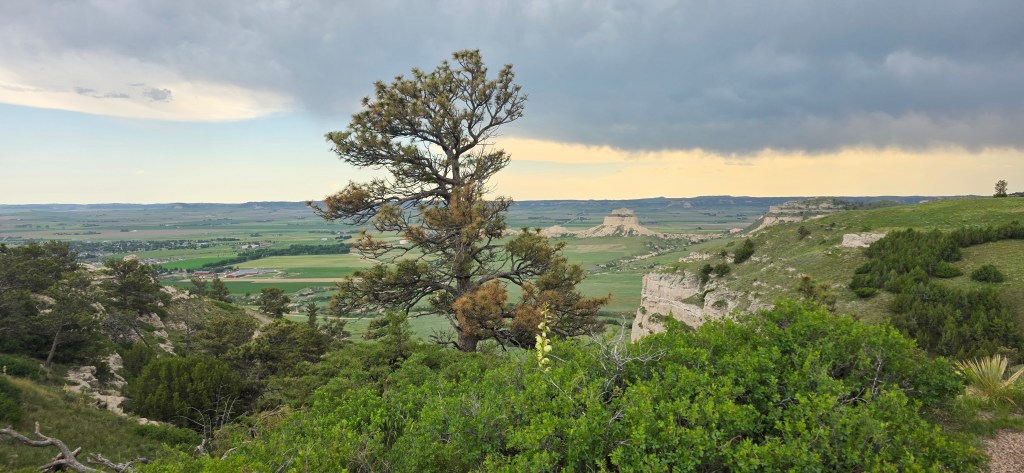
As we drove across Nebraska, we followed the Platte and North Platte rivers. It became very obvious just how vital the river systems were in this region. The towns, rivers, railroads, roads, and farms were all clustered along the river, and I was surprised at the amount of woodland. I recognised some of the cottonwood trees that were so important in the nineteenth century.
From Scottsbluff, you have a fantastic view across the plains, where you can see the farmlands and trees along the Platte, with rolling grasslands beyond. The changing topography was clear once we left Scottsbluff and drove north on Nebraska 71, gradually climbing out of the river valley before climbing over the bluffs. Then, the land became rolling grassland. I could see why travellers in the nineteenth century claimed that being on the grasslands was like being at sea and how easy it was to get disoriented.
It was clear how these rivers would attract the bison that roamed the plains, and it is equally important to recognize their significance to Native Americans. They provided essential resources such as water for agriculture, wood for fuel, and food for horses—particularly cottonwood bark during the winter months—as well as woodland areas that offered shelter from harsh winter storms. For Native American tribes who lived on the Plains, such as the Lakota, Cheyenne, Arapaho, and Comanche, the rivers served as vital lifelines, central to their hunting patterns, trade networks, and spiritual practices.
It was also easy to understand how early migrants heading to California, Oregon, or Utah had followed these river valleys. Not only was the land flat and easy to cross, but they had access to water and wood. Railroads, too, followed the same routes. Soon, the bison and Native peoples were driven away from the rivers, and this development became a major source of tension and dispute.
As migrants and railroads pushed west, it was easy to see why there would be so much conflict. Control of the rivers was central. This was not just a story of the Platte, but also the Missouri, Arkansas, Kansas, and Red Rivers. Across the plains, rivers were central to transportation and agriculture. They were the focus of much of the conflict between the United States and the Native American peoples, whose homelands were on the Plains.
Native peoples perceived the growing American presence, the movement of wagon trains, and the construction of railroads along their rivers as a direct threat to their way of life. The bison, which were central to the economies and cultures of the Plains, soon began to disappear from the river valleys. Tensions ultimately escalated into violence. The Grattan Massacre of 1854 near the North Platte set off the First Sioux War. Later, during Red Cloud’s War (1866–1868), the Bozeman Trail—which crossed multiple tributaries—became a battleground over control of river access and surrounding lands.
The response of the U.S. government was twofold: to negotiate and to subdue. Treaties like the Fort Laramie Treaty of 1851 and its 1868 revision sought to establish borders around Native lands, often designating rivers as natural boundaries. However, these agreements were frequently violated as new gold discoveries and railroad plans prompted further encroachments. It will be interesting to see how this is reflected when we visit the Black Hills.
 Early American Musings
Leave a comment