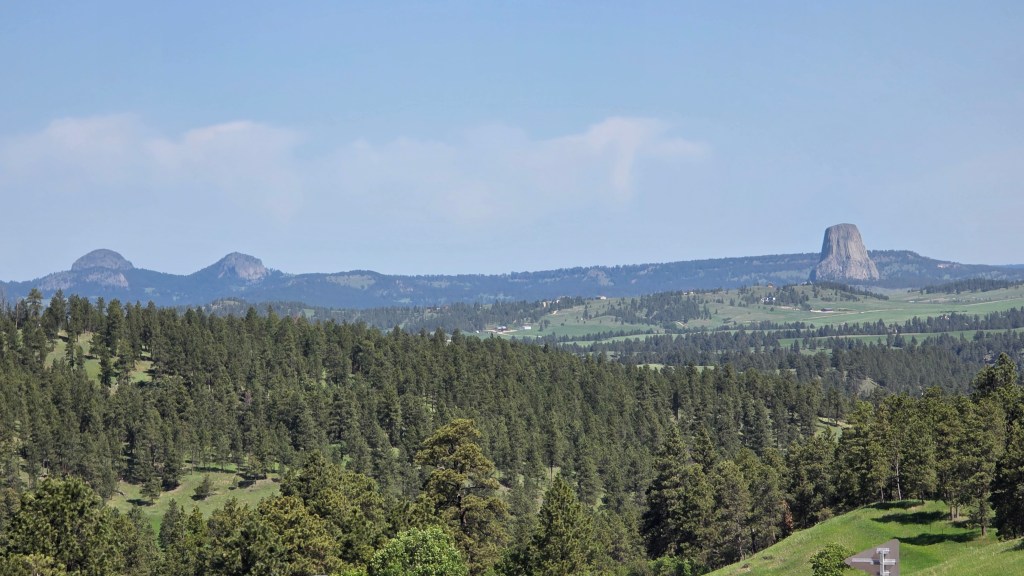
One thing we noticed first up at Wounded Knee, particularly around the memorial, but then again today at Devil’s Tower, were pieces of brightly coloured cloth tied to the branches of trees. I realised that these were Native American prayer ties.
Prayer ties, deeply rooted in the spiritual traditions of Plains tribes such as the Lakota, Dakota, Nakota (Sioux), Cheyenne, and Crow, serve as tangible expressions of prayer, intention, and sacred connection. Though their exact origins are unrecorded due to the oral nature of Indigenous traditions, tribal elders affirm that prayer ties have long been a part of pre-contact ceremonial life, particularly within Lakota practices.
At their core, prayer ties reflect a Native worldview grounded in balance, reciprocity, and interconnectedness. Each small cloth bundle—typically red or yellow and filled with sacred tobacco—is made by hand, with the maker breathing or speaking a prayer into it. The act of creating a prayer tie is itself a ritual intended to channel prayers for healing, guidance, protection, or gratitude to the Creator or the spirit world.
Used widely in sacred ceremonies such as vision quests, sweat lodges, and the Sun Dance, prayer ties are often strung together and arranged around ceremonial spaces. They serve as spiritual boundaries and tools of consecration. However, their use extends beyond communal rites. Many Native individuals create prayer ties privately and leave them as offerings at sacred natural sites, such as Bear Butte or Devil’s Tower.
The symbolism embedded in prayer ties is rich and deliberate. Tobacco, a sacred plant, is believed to carry prayers with clarity and sincerity. The colors of the cloth often correspond with the four cardinal directions—red (south), yellow (east), black (west), and white (north)—aligning with the teachings of the medicine wheel and emphasizing harmony in life.
Importantly, prayer is not seen as a passive act in Indigenous traditions but as a reciprocal exchange. Offerings like prayer ties are made not to request favors but to honor the ongoing relationship between humans and the spiritual world.
Despite the simplicity of their appearance, prayer ties represent profound spiritual meaning—threads of intention that continue to connect generations with the sacred forces of the earth and sky.
I discovered that Devil’s Tower is a significant site for Native American prayer, vision quests, and ceremonial offerings. Every June, many Native communities gather there to participate in sun dances and other sacred rites, often leaving prayer cloths or bundles tied to trees in reverence. The tower is regarded as a living being, a place where the veil between the physical and spiritual worlds is fragile. I noticed that there was now a climbing ban during June to recognise the importance of the place and time to Native American peoples and cultures.
However, what I also noticed was that many of these prayer ties were not bundles of tobacco but were simply pieces of cloth. In quite a few instances, they were merely bandanas tied to branches. I couldn’t help but wonder how far this represented a cultural misrepresentation, possibly even an a cultural appropriation of the original idea. Had tourists seen some Native American prayer bundles and decided to add their own without fully understanding the meaning and symbolism?
I thought about this even more when, later in the day, we stopped in a gift shop that sold a wide array of Native American goods from Navajo blankets (in Montana?) to dream catchers. Dream catchers have almost become a symbol for me of how Native American cultural items have been appropriated and misused. Hanging above beds, in windows, or even from rearview mirrors, the dream catcher has become one of the most widely recognised symbols of Native American culture.
The dream catcher, in its most authentic form, originates from the Ojibwe people of the Great Lakes region. According to Ojibwe oral tradition, the dream catcher was inspired by Asibikaashi, the Spider Woman, a spiritual figure who cared for children and the people of the land. As the Ojibwe people spread out across North America, it became increasingly difficult for Asibikaashi to watch over everyone. Hence, mothers and grandmothers began weaving magical webs for their children, using natural materials such as willow hoops and sinew. These webs were intended to act as filters, catching bad dreams and letting only good ones pass through.
Traditionally, dream catchers were small—just a few inches in diameter—and hung above cradles or sleeping areas. Their hoops represented the circle of life and the cyclical nature of seasons and time. The web in the centre mimicked a spider’s web, symbolizing protection and interconnectedness.
Over time, especially during the Pan-Indian Movement of the 1960s and 1970s, the dream catcher began to be adopted by other Native nations outside the Ojibwe, including the Lakota and Cherokee. It came to symbolize broader themes of Native unity, identity, and resistance in the face of cultural erasure.
By the late 20th century, dream catchers had gained popularity outside of Indigenous communities, becoming a familiar symbol of Native culture in popular art, fashion, and New Age spirituality. Media exposure, tourist markets, and growing public interest in Native American traditions fueled this widespread adoption. I’ve seen them on sale from Nova Scotia to California, as well as across Europe and most people seem to have little idea about what they symbolise.
I can’t help but wonder whether this symbolises a re-emergence and success of Native American culture, or the appropriation and bastardisation of Native American imagery for corporate profits.
 Early American Musings
Leave a comment