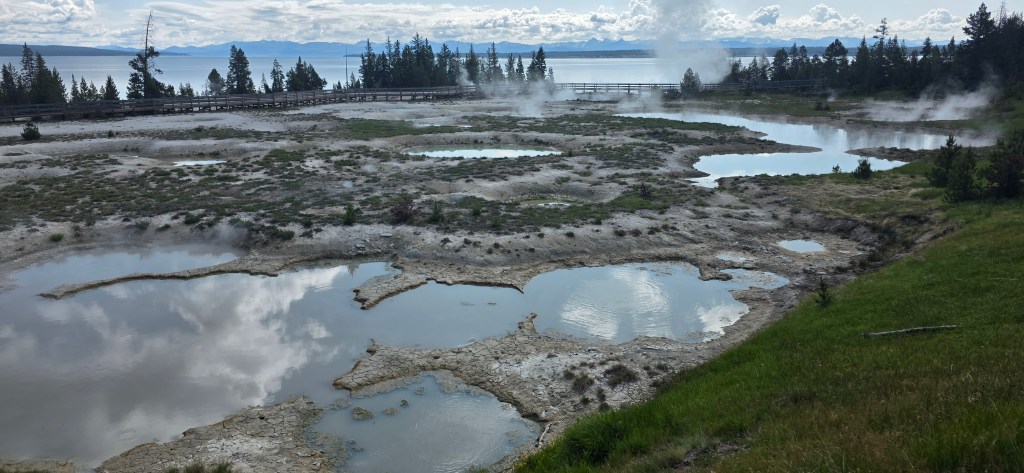
We pushed on to Yellowstone, one of the leading destinations of our trip. The park was stunning, and we were left with some indelible memories. In particular, I will remember an early morning walk along the shores of Yellowstone Lake and encountering a small group of bison grazing close to our cabin. The scenery is spectacular, and I did not know that there were so many different hot springs around the park. We got to see Old Faithful, of course, and it was a great show. We were also thrilled to see a wolf, as well as an assortment of buffalo and elk.
Yellowstone is a significant site because it was the first national park to be established, not only in the US but in the world. It was set up by the administration of President Ulysses S. Grant in 1872. The act set a groundbreaking precedent, preserving the land “for the benefit and enjoyment of the people” and placing it under federal protection. This idea of setting aside land for public use was revolutionary at the time and laid the foundation for the national park system.
The size of Yellowstone is also significant, and it was something I wasn’t entirely sure I had fully comprehended before we arrived. Yellowstone spans approximately 3,472 square miles (or around 8,991 square kilometers). The landscape is varied and dramatic, ranging from rugged mountains and deep canyons to vast forests, rivers, and alpine meadows. Yellowstone Lake, one of the largest high-elevation lakes in North America, sits in the park’s southeast quadrant. At the same time, the mighty Yellowstone River runs through the Grand Canyon of the Yellowstone, a dramatic gorge known for its multicolored rock walls and waterfalls. It sits atop the Yellowstone Caldera, the largest supervolcano in North America. Although the volcano is currently dormant, the park’s unique geothermal activity—including geysers, hot springs, mud pots, and fumaroles—are reminders of the powerful geologic forces beneath the surface.
What I wasn’t ready for was how busy the park was. We sat in traffic jams and couldn’t visit the Grand Prismatic Spring because the parking lot was closed due to overcrowding. The park welcomes between 3 and 4.5 million visitors annually, primarily between late spring and early autumn, with July and August being the peak months. We visited mid-week in mid-June, so it wasn’t quite peak, but the park was still overwhelmed by the number of visitors. If I were to go back, I’d probably try to visit in May or September.
The American National Park system inspired the establishment of the British National Parks, but the British National Parks are quite different. Britain’s national parks were established much later, with the first—Peak District National Park—established in 1951. Their creation was influenced not by the desire to preserve wilderness but to safeguard treasured landscapes already shaped by human activity. The British model places equal emphasis on conservation, public enjoyment, and the protection of rural communities and traditional ways of life. So the parks are full of towns and villages, which are often the main attractions.
The difference in physical size between the parks is stark. US national parks are often enormous. For example, Yellowstone spans about 3,472 square miles (9,000 square kilometres), while the largest U.K. national park, the Cairngorms in Scotland, (a relatively new park established in 2003) covers around 1,748 square miles (4,528 square kilometres). The Lake District is the largest national park in England, covering 885 square miles (2,292 square kilometres.)
The crowds somewhat destroyed the atmosphere of Yellowstone, but I was struck by how quickly you could leave the crowds behind on the few relatively short hikes I took. It was almost as if people didn’t want to leave their cars behind. I am unsure what the solution is to overcrowding. We are heading to Yosemite soon, which I have been warned is even busier, and it has now introduced a ticket system.
But Yellowstone is not just a tourist destination; it’s a living laboratory for environmental science and a critical haven for biodiversity. The park is part of the Greater Yellowstone Ecosystem, one of the largest nearly intact temperate-zone ecosystems in the world, encompassing over 22 million acres.
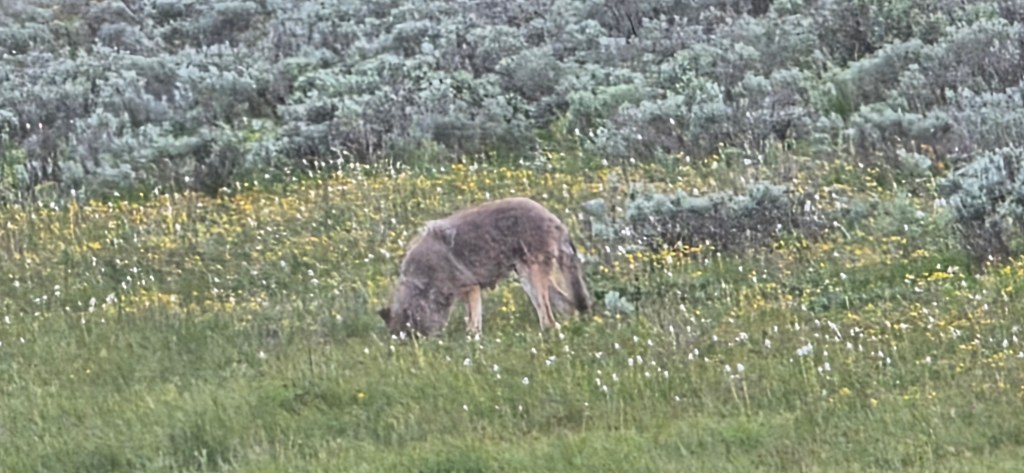
Several high-profile conservation efforts have taken place in Yellowstone. In 1995, grey wolves were reintroduced to the park after being eradicated in the early 20th century. Their return restored balance to the ecosystem, controlling elk populations and enabling vegetation to recover. We were excited to see a wolf quite close to the road. It seemed like it wasn’t at all afraid of the crowds of tourists who were snapping photographs. (Even I sneaked a quick photo from within the car.) There has been considerable discussion in Cairngorm National Park, Scotland, about the possibility of reintroducing wolves to control the deer population; however, the proposal has faced significant opposition.
Yellowstone hosts the largest free-roaming bison herd in the contiguous US, but managing the herd is complex due to concerns about disease transmission to livestock and land use outside park boundaries. We were very excited to see free-roaming bison, but they soon became so common they didn’t inspire any excitement.
We left Yellowstone with many great memories but also with some relief at leaving the crowds behind.
 Early American Musings
Leave a comment