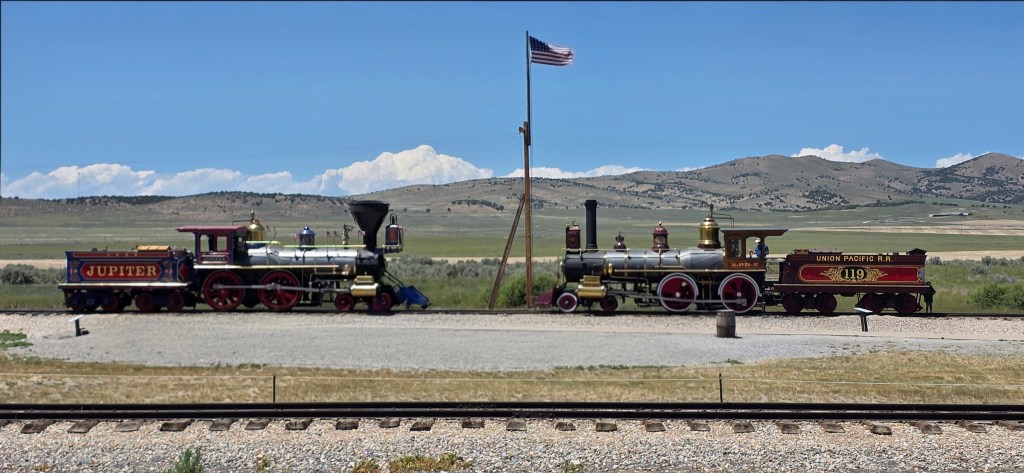
We drove down to the Golden Spike National Historical Park. The park, a testament to human ingenuity, commemorates the joining of the Union and Central Pacific railroads. It is the site where the final golden spike was driven in to celebrate the uniting of East and West. In many ways, this is a significant site, almost as important as Independence Hall. The construction of the railroads, particularly the transcontinental railroad, was a monumental feat that transformed the United States.
The railroad, while transforming the connection between East and West, also significantly altered the lands it crossed. It was a key factor in the dispossession of the Native American peoples of the Plains. Not only did it move people onto the plains, but it drove away the buffalo upon which Native American peoples relied. Railroad crews brought diseases such as cholera and dysentery with them, and the men themselves were prone to fight and quarrel. (Many of the towns became known as ‘hell on wheels.’) It wasn’t unusual for Native Americans to get caught up in the crossfire.
The transcontinental railroad covered 1900 miles from Omaha, Nebraska, to Sacramento, California. It transformed the transportation of people between East and West. Before the railroad, it had taken months for an individual to get from East to West, either trekking across the Plains by wagon or on horseback or taking a sea journey around Cape Horn or across the Isthmus of Panama. Now, the trip could be completed in under a week. This made the West much more accessible, encouraging people to move and facilitating the spread of information about the West to the East.
Economically, it helped to create a national market, but this did not happen immediately. Initially, the transportation costs were too high for heavy freight to be shipped. It also didn’t significantly transform communication, as the telegraph had already been established and remained the primary means of communication between East and West.
The railroads, however, did facilitate economic development, both from the demand that they created for iron and steel and later by their shipping of produce. They also served to open up the West, as the main way the railroads made profits was not by selling tickets but by selling land. Western railroads got huge grants of land, and it was the sale of land that led to their construction. This was also the reason that the Union and Central Pacific Railways continued to construct their tracks past Promontory Summit, as no one knew where the lines would meet. You can see the two parallel track grades at the Golden Spike site.
The site’s museum was fascinating, and they had the reconstructions of the two locomotives that were at Promontory Point when the Golden Spike was driven in, which you could look into, and they ran them around the site. Yet what surprised me, particularly after the crowds at Yellowstone, was that there was hardly anyone there. There were perhaps another 20 people at the visitor centre, and it was a free day as it was Juneteenth. I don’t understand why historical sites seem to attract so little interest.
 Early American Musings
Leave a comment