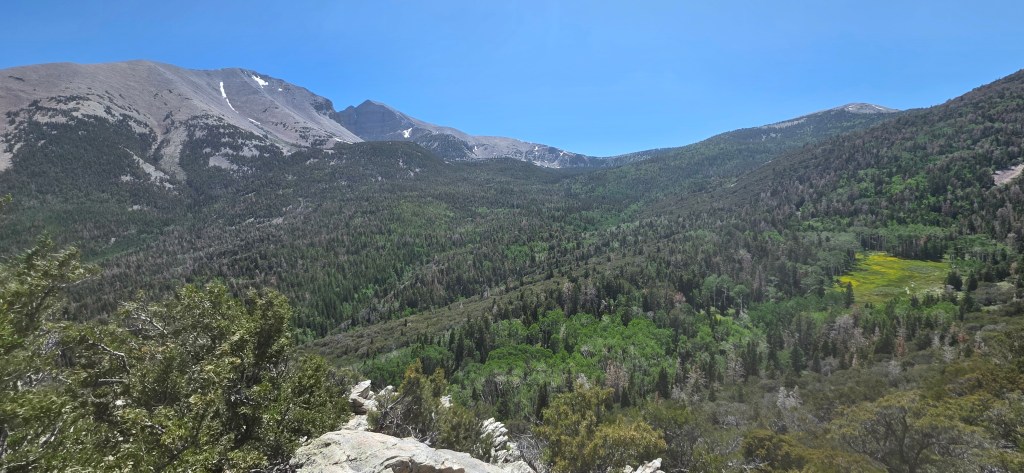
We drove from Salt Lake City to Carson City, mainly on US Route 50. We stopped off in the Great Basin National Park and explored Wheeler Peak in the Snake Range—driving up the scenic drive almost to the peak itself. I was shocked at the mountain. We started off in scorching 40-degree heat in the parched Nevada desert. As we ascended the mountain, it got cooler and greener. At the top of the drive, it was only 20 degrees, and above us, we could see the snowfields on the peak. What struck me was this isolated island of green in the middle of the desert. Indeed, it is even more isolated than that because you have several different climatic zones on the mountain. This is a source of immense variety of flora and fauna.
The National Park Service had put up some interesting signs explaining how the animals on the peak and the surrounding hills were diverging from their species. This is like an isolated island for fish and small mammals who have effectively been stranded here since the end of the last ice age.
This also made me think about the roles that the region must have played for Native American peoples in a similar way that the Black Hills were central to the Sioux. But the Snake Range is an even more dramatic contrast, a region of forests and lakes in the middle of the desert. The park visitor centre had some information on this, explaining that the area was important to the local Shoshone and Paiute peoples both as a source of food and supplies, and as a spiritual centre. For the Shoshone, particularly the Western Shoshone bands, the entire Snake Range, including Wheeler Peak, lies within ancestral territory and is embedded with sacred meaning. Mountains in Shoshone cosmology are often regarded as the dwelling places of powerful spirits and deities. The Snake Range, with its lofty peaks and deep hidden valleys, was seen as a site of spiritual potency where the physical and spiritual worlds intersect. Vision quests—a rite of passage for Shoshone youth—were sometimes undertaken in the isolation of the range, where individuals fasted, prayed, and sought guidance or personal revelation from spiritual beings. The area’s natural features, such as springs, rock formations, and caves, were considered portals or markers of spiritual presence.
Similarly, the Ute people, particularly the Southern and Western Ute bands, view the Snake Range as a place of cultural memory and spiritual practice. The Utes have long traditions of mountain reverence, believing that some high-altitude regions are sacred and must be approached with humility and ritual. Stories passed down from generation to generation tell of the range as the home of spirit beings . Ute elders have identified locations within the range associated with oral histories, origin stories, and ceremonial events, reinforcing the area’s enduring cultural relevance.
Both the Shoshone and Ute peoples have traditional ecological knowledge deeply tied to the Snake Range. The range provided food, medicines, and materials essential to daily life, such as pine nuts, roots, and herbs, as well as habitats for game animals. The act of gathering these resources was often accompanied by rituals or offerings, acknowledging the spiritual guardians of the land. This practice reflects a worldview in which nature is animate and deserving of respect, not merely a backdrop for human activity.
I could see how the arrival of horses in the region would have transformed the roles of the peaks. Following Spanish contact in the early sixteenth century, horses spread across the Southwest, at first slowly, but after the Pueblo Revolt of 1680. By the late 17th century, southwestern peoples, such as the Ute and Eastern Shoshone, had adopted a horse culture. This changed their culture in many different ways, but most importantly, it allowed them to move much greater distances and transport much greater quantities of goods for trade. The Snake Range would have been much more accessible and much more important.
I was really not expecting to see such a stark contrast and to see such lush meadows and forests in the middle of the desert.
 Early American Musings
Leave a comment