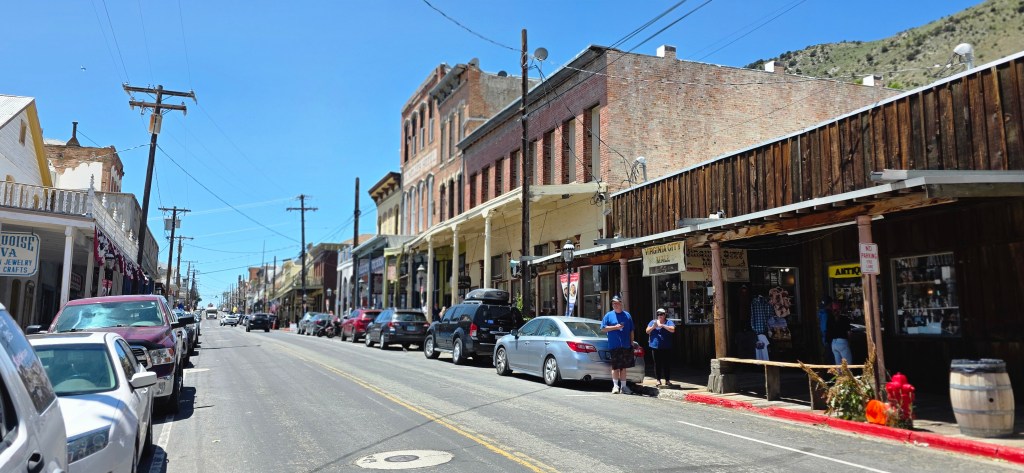
Heading west, we pushed on to Virginia City. I found this a strange town. In some ways, it is the best preserved of the western towns, with the wooden sidewalks and old saloons and gambling dens. But in other ways, it is a caricature of itself with gun-fights performed three times a day and a reconstruction of a gold mine for you to view in the Way It Was Museum.
Interestingly, Virginia City’s wealth did not come from gold, but from silver. The Comstock Lode, discovered in 1859, was one of the richest silver deposits ever found. The hills surrounding the town were soon crawling with prospectors eager to sink their picks into the newfound wealth. Virginia City sprang into existence virtually overnight, mushrooming from a rough mining camp into a full-fledged town by the early 1860s. Unlike the anarchic tent settlements of earlier gold mining towns, Virginia City became, relatively quickly, a centre of order and innovation. With an estimated population peaking at over 25,000 in the mid-1870s, it rivalled San Francisco in its sophistication and style.
If the mines were Virginia City’s heart, the saloons were its bloodstream. By some accounts, the town boasted more than a hundred saloons at its peak, offering not just liquor but escape, camaraderie, and entertainment. Drinking was not merely a pastime but a social glue—uniting labourers, gamblers, businessmen, and even journalists. Rich and poor were united in their quest for release from the tedium of day-to-day life. The culture of gambling flourished alongside drinking, with establishments like the Delta Saloon providing ornate spaces for poker, faro, and roulette. These gambling halls were not just dens of vice; they were vital social institutions where fortunes were won and lost and reputations made or broken. Many of these establishments catered to class as well as taste—lavish interiors for the wealthy mine owners and more humble affairs for the dusty prospectors.
Samuel Langhorne Clemens, better known by his pen name, Mark Twain. Clemens arrived in the town in 1861, lured like so many others by the promise of mineral wealth. Though he briefly tried his hand at prospecting, Twain’s big break came not in a mine but at the office of the Territorial Enterprise, the town’s leading newspaper. There is, or perhaps was, a museum to him in town, but it was closed and looked like it may be permanently closed. This is a shame, as Twain’s Roughing It, a semi-autobiographical account, is one of my favourite works and really serves to bring the West of the 1860s to life.
Less a conventional memoir than a satirical tall tale with one foot in historical fact and the other in fiction, the book captures the chaos, comedy, and contradictions of frontier life with Twain’s trademark wit. Beginning with his journey westward to Nevada—accompanying his brother, newly appointed secretary of the Nevada Territory—Twain takes readers through a kaleidoscope of desert trials, mining busts, vigilante justice, and boomtown absurdities, including his stint as a prospector and journalist in Virginia City. His Virginia City episodes, drawn from his time at the Territorial Enterprise, are especially vivid, portraying a world where duels could be fought over editorial slights and where miners’ dreams evaporated faster than the silver they pursued. Twain gleefully mocks pretension, gullibility, and the manic optimism that characterised the mining frontier, yet his affection for the place and its people is unmistakable. It is unfortunate for me, as a historian, that it is not always easy to separate fact from fiction, but that is what makes this book so readable, and I am always surprised that it is not a better-known work by Twain.
We arrived in town on the V&T Railway, a restoration of part of the Virginia and Truckee Railroad from Carson City into Virginia City. The V&T connected Virginia City with Carson City and Reno and, thereby, with the Central Pacific line of the transcontinental railroad. It facilitated not just the export of silver and the importation of goods but also the movement of people and ideas. Entrepreneurs, entertainers, and opportunists arrived with increasing frequency, broadening the town’s social fabric and diversifying its economy—if only temporarily.
The railroad also hastened Virginia City’s alignment with national markets and culture. It enabled the import of luxuries that seemed absurdly out of place in a desert mining town: French wines, Eastern newspapers, and Parisian fashions. For a brief time, the frontier had all the trappings of metropolitan grandeur. Some of this still seems to remain in the town.
Like all boomtowns, Virginia City was prey to the very forces that created it. By the late 1870s, the silver veins had begun to yield less, and the economic downturn of the Panic of 1873 hastened the town’s decline. The mines closed, people left, and many of the once-vibrant institutions fell into disrepair.
Fires also played a destructive role. The Great Fire of 1875 devastated much of the town, though it was rapidly rebuilt. But even restoration could not halt the inevitable ebb of mining prosperity. The once-lavish hotels emptied, the saloons grew quiet, and the streets lost their lustre.
By the early 20th century, Virginia City had become a shadow of its former self, populated by a few hundred residents, with dusty ghosts of its past grandeur lingering in empty storefronts and half-collapsed homes.
During the 20th century, particularly after World War II, the town began to rebrand itself as a living museum of the Old West. Tourists replaced miners, and heritage supplanted silver as the town’s chief commodity. The preservation of its historic buildings—many of them registered landmarks—helped secure its reputation as one of the most authentically preserved mining towns in the United States.
Virginia City has preserved not only its architecture but also some of its attitude. The town embraces its theatrical heritage, hosting reenactments, costume parades, and festivals that celebrate its origins. The distinction between myth and history is not only blurred but trampled upon. In many ways, the town serves as a recreation of Roughing It, artfully intertwining fact and fiction to create a captivating narrative—one that is not always entirely accurate.
 Early American Musings
Leave a comment