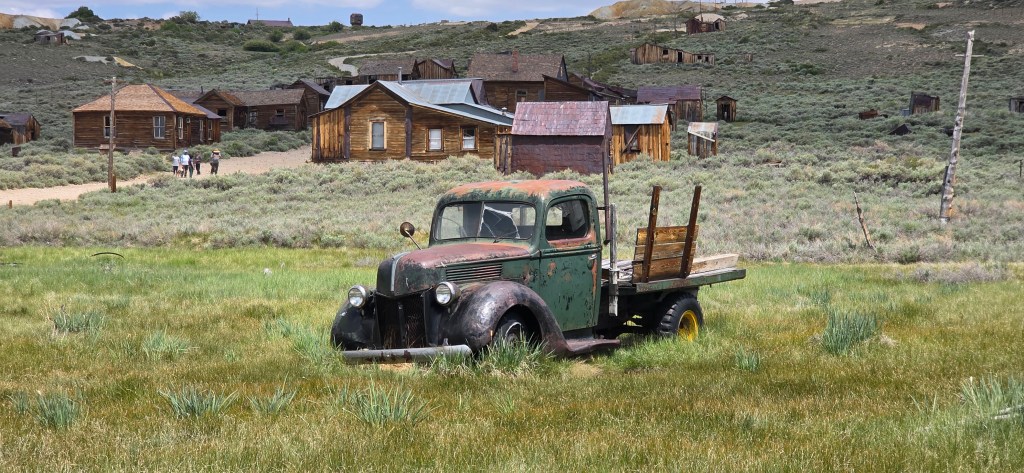
After visiting Carson City, we visited an authentic western mining town, Bodie, in California. Bodie sits high in the Sierra Nevada, where snows linger well into the spring. Indeed, the site does not reopen until May because the winding dirt road is blocked by snow. After climbing along the narrow dirt road for thirteen miles, Bodie suddenly appears over the brow of a hill. It is a striking sight: a real ghost town, full of abandoned buildings with many of their contents and even abandoned cars.
Bodie’s origins date back to 1859 when prospector William S. Bodey discovered gold near what would become the town’s site. However, Bodey died in a snowstorm shortly after and never witnessed the town that would bear his name. Bodie was no more than a small mining outpost for nearly two decades, overshadowed by more prosperous neighbours like Virginia City. However, in 1876, the Standard Company struck a wealthy vein of gold ore, and Bodie’s fate dramatically changed.
The discovery sparked a frenzy. By 1879, Bodie’s population had exploded to nearly 7,000 residents. The town quickly transformed into one of the most infamous settlements in California. Its main street, a mile long, was packed with saloons, gambling halls, brothels, and general stores. At its peak, Bodie boasted over 60 saloons—roughly one for every 100 residents—and had such a notorious reputation that a young girl reportedly wrote in her diary, “Goodbye God, I’m going to Bodie.” Whether apocryphal or not, the quote captures the moral anxieties surrounding the town’s reputation.
The absence of a strong legal system—the absence of courts and agents to enforce the law—the number of single unmarried men, and the prevalence of alcohol-fuelled disputes meant that it was difficult to enforce order in Bodie. Like many other mining towns, there was frequent violence. Gunfights were common, and the town soon got a reputation for lawlessness that rivalled that of Tombstone or Deadwood. Vigilante justice often filled the vacuum left by inadequate policing, and lynchings were not unknown.
Yet, as in many other Western towns, beneath the superficial chaos was a community striving for permanence and respectability. Bodie had schools, churches, social clubs, and even a brass band. There were Sunday picnics, masquerade balls, and ice-skating parties in winter. Families made homes here, children were born, and people—despite the dust, the danger, and the devil-may-care attitude—called it home.
Immigrant populations, particularly Chinese and Irish workers, played a significant role in Bodie’s development. Chinese residents, who settled in a small enclave on the town’s south end, faced systemic discrimination but managed to establish a vibrant community with its own businesses, herbal doctors, and a Taoist temple. Their story is often overlooked in Bodie’s history, but they were vital to the town’s social fabric.
Bodie owed its success in part to new technology. The Standard Company introduced new techniques to crush ore and extract gold using mercury, which, while environmentally catastrophic by modern standards, was cutting-edge for the time. Bodie was also one of the first places in the USA to receive hydroelectric power 1892.
The town also had rail connections and stagecoach lines that tied it to Carson City, Reno, and the Central Pacific Railroad. Despite its remote location—8,400 feet above sea level and snowbound much of the year—Bodie managed to maintain trade links and receive goods from San Francisco and beyond.
However, the boom soon ended, and the accessible ore was soon mined out. Smaller mining operations were pushed out, and larger mining companies consolidated their holdings, but despite this, profit margins still shrank. Bodie’s poBodie’sn started to decline, falling to around 1,500 by 1881. Fires—common and devastating in wooden frontier towns—accelerated the town’s demise, particularly a destructive blaze in 1892 that destroyed a significant portion of the business district. Another in 1932, effectively sealed the town’s demise. The Great Depression offered a brief flicker of revival as gold prices rose and small-scale mining resumed. However, it was not enough to counteract the long-term downward trend. By the early 1940s, the last mine had closed, and the town’s remaining residents trickled away. Bodie, once a byword for raucous prosperity, became eerily silent.
Unlike many other boomtowns that were dismantled for their lumber or materials, Bodie was left largely intact, thanks in part to its remote location and the foresight of those who saw value in its preservation. In 1962, the town was designated a California State Historic Park. Since then, it has been maintained in a state of “arrested “decay.” That is, the structures are preserved as they were found: not rebuilt, but stabilised, weatherproofed, and protected against further ruin.
This is a contrast to reconstructions such as Williamsburg, collections of houses removed from other locations, such as the Stuhr Museum or Missouri Town, or the active towns such as Deadwood and Virginia City. Bodie possessed an eerie sense of the past. Many of the houses still contained the items that were left behind when their last residents left. A museum in the town, run by the park, contained collections of people’s possessions. This gave a very strong sense of what life in the town must have been like, and was much more evocative than the pristine neatness of Williamsburg. It was undoubtedly an unforgettable visit.
 Early American Musings
Leave a comment