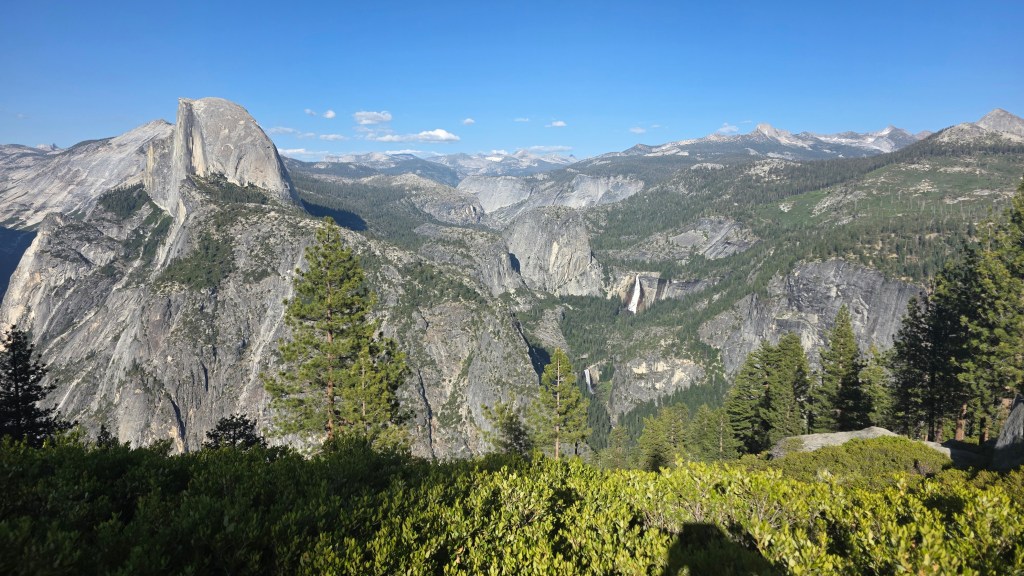
We went on to Yosemite. Yosemite was awesome in several ways. First, it was stunningly beautiful; second, it was stunningly busy.
Yosemite has to be one of the most special spots on earth. Nothing had prepared me for the grandeur of the site.
The park’s elevation ranges dramatically from 2,127 feet to 13,114 feet at the summit of Mount Lyell, the highest point. It encompasses five major vegetation zones that range from oak woodlands to alpine tundra.
We drove over the Tioga Pass from Lee Vining through beautiful alpine meadows full of flowers and crystal-clear lakes. Then we descended into Yosemite Valley, a glacially sculpted basin just seven miles long and about one mile wide. On either side, sheer granite cliffs rise more than 3,000 feet above the valley floor. Here are some of the most famous sights, particularly the iconic El Capitan, a 3,000-foot vertical rock face that challenges even the most seasoned climbers, and Half Dome, with its distinctive smooth crest carved by glacial activity. Cascading over these cliffs is the 2,425-foot-high Yosemite Falls, the tallest waterfall in North America and one of the highest in the world. The valley is truly magical. Its beauty is exceptional and so special. The view from Glacier Point is all but indescribable. The whole park is a treasure trove of unparalleled beauty and stunning views.
One result of this is that Yosemite is one of the most visited National Parks, receiving 4 million visitors annually. Arriving in the valley felt less like visiting an oasis of tranquillity and beauty and more like being stuck in rush hour traffic. The roads have been converted into a one-way system to handle the traffic, and although the speed limit is supposedly 25 miles per hour, cars and busses, pickups, and RVs were all jostling for space and speeding around. It took us over an hour to park, and then, as recommended, we headed for the shuttle bus. There was a very long line, and the first two buses were full. Eventually, we boarded the third, crushed in like sardines, feeling rather like the rush hour tube in London. We decided to head to Mirror Lake. The tour guides describe Mirror Lake as “a serene and enchanting spot that captures the park’s quiet magic. Its reflective waters—especially in spring and early summer—offer one of Yosemite’s most iconic views.” Serene and enchanting would not be words I would apply. It reminded me of Blackpool Beach on a warm August Bank Holiday. I would guess there were a couple of thousand people there, some with inflatables, some with BBQs, some with boomboxes. It was anything but tranquil. There were crowds of people playing in the water. This was undoubtedly the biggest disappointment of our entire trip.
This made me think about Yosemite’s role as a trailblazer for conservation. The roots of the park stretch back to 1864, in the middle of the Civil War, when President Abraham Lincoln signed the Yosemite Grant Act, which set aside Yosemite Valley and the Mariposa Grove “for public use, resort, and recreation.” However, while the land was technically protected, enforcement was weak, and infrastructure was minimal. Grazing and logging continued, and pressure mounted to provide better stewardship. Enter John Muir, the Scottish-born naturalist, writer, and mountaineer whose deep love for Yosemite’s landscapes would change the course of conservation history.
Muir is widely celebrated in Scotland, but in 1868, he visited Yosemite and quickly became one of its most passionate advocates. Through articles and books, he communicated the spiritual and scientific importance of wilderness. His writings captivated the public and brought national attention to the threats facing Yosemite and other wild places. Muir viewed wilderness as sacred and argued that preserving nature was not just about scenery but about safeguarding a deeper, transcendent value.
In the 1880s, Muir began campaigning for federal control of Yosemite to ensure better protection. His efforts, along with support from growing conservationist groups, culminated in the establishment of Yosemite National Park on October 1, 1890. The park encompassed a much larger area than the original grant—covering the surrounding high country and watersheds—but left Yosemite Valley and Mariposa Grove under state jurisdiction until 1906, when they were finally incorporated into the park.
Yosemite’s creation helped inspire the broader American conservation movement, which was gathering momentum at the turn of the century. Figures like Gifford Pinchot, Theodore Roosevelt, and later Stephen Mather built on the legacy of Yosemite, promoting the idea that natural resources and landscapes should be preserved, studied, and enjoyed by all Americans. Yosemite, often described as the birthplace of the national park idea, became both a symbol and a proving ground for this philosophy.
In the twenty-first century, how can national treasures like Yosemite, as well as places like Yellowstone and Devil’s Tower, cope with the influx of tourists? How can they be both preserved AND enjoyed by all Americans? Their roles as economic generators for the local economies is essential, but how can these sites be preserved for future generations? Yosemite has introduced a ticket system, limiting the number of visitors per day in the summer, but it was still desperately overcrowded. Should admission charges be increased until visitor numbers drop? But then, why should the treasures of the American landscape only be accessible to the rich?
I’m really not sure what the answer is, but it has perplexed me. It does strike me that the United States has some of the most beautiful scenery in the world, but that while some areas are all but empty, others are desperately overcrowded. In some ways, creating a National Park seems to threaten an area rather than preserve it. Perhaps the state parks should be better publicised, as I have visited some great state parks over the years.
 Early American Musings
Leave a comment