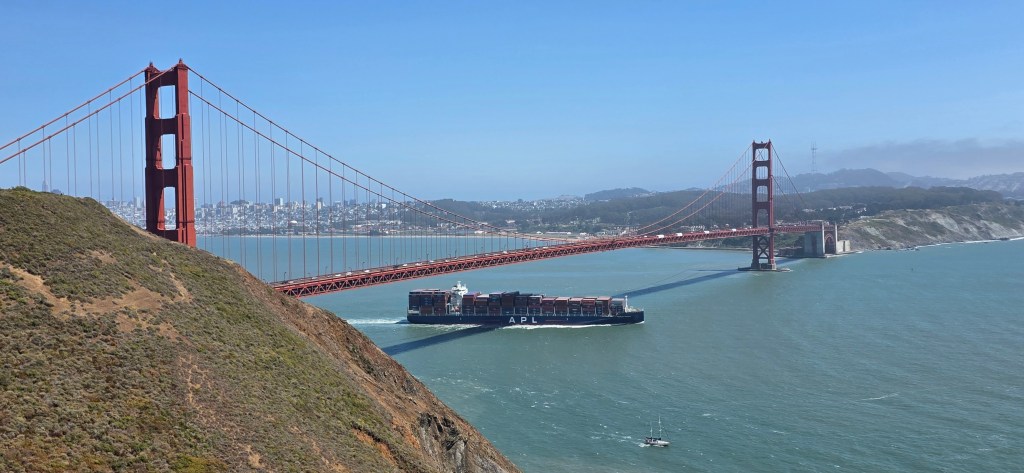
We drove across the Central Valley to San Francisco. Coming across the San Francisco-Oakland Bay Bridge, it was easy to see why San Francisco had developed into such an important city. The bay is simply huge, and the harbour is well-sheltered. It offers easy access to the interior of California, including the goldfields that would be exploited in the nineteenth century. The miners who worked in these fields needed to get the gold out and import some of the luxuries of life. That was why towns such as Virginia City in Nevada could acquire luxuries from Europe.
Long before European colonization, the bay area was home to numerous Indigenous groups, including the Ohlone people. These communities fished, gathered shellfish, and navigated the waters in tule reed canoes, engaging in local and regional trade. The area was abundant in resources, and its waterways were central to sustaining the Indigenous economy and way of life.
While English navigator Sir Francis Dake had sailed up the California coast in 1579, he did not enter the bay, and Spanish explorers were the first Europeans to enter the bay in 1769, with Juan de Ayala sailing the San Carlos into the harbor in 1775, becoming the first known European vessel to do so. Soon after, Spanish colonial authorities established the Presidio of San Francisco (1776) and Mission San Francisco de Asís (Mission Dolores), beginning a sustained European presence. Despite the harbour’s natural advantages, it remained underdeveloped through Spanish and Mexican rule, overshadowed by other ports such as Monterey.
In 1846, American troops arrived during the Mexican-American War, and in the Treaty of Guadalupe-Hidalgo, Mexico ceded much of the West, including California to the United States. The discovery of gold at Sutter’s Mill in the Sierra Nevada foothills in January 1848 transformed San Francisco Harbor into the busiest and most vital port on the West Coast. As news of gold spread worldwide by the end of 1848, a massive wave of migration known as the Gold Rush followed. San Francisco, then a small settlement with a population of around 1,000, became the primary entry point for “Argonauts” arriving by sea from the eastern United States, Latin America, Europe, Australia, and China. San Francisco Harbor became the de facto gateway to the California gold fields. Most travellers and merchants sailed around Cape Horn or took a combination of ship and land travel via the Isthmus of Panama to reach the port. Upon arrival, they faced another journey inland—over land or up the Sacramento and San Joaquin Rivers—to get to the mining districts of the Sierra Nevada.
The city’s waterfront was ill-prepared for this influx. Between 1848 and 1850, the population of San Francisco skyrocketed from under 1,000 to over 25,000. The harbour became congested with hundreds of ships, many of which were abandoned by crews lured by gold fever. These vessels, often left to rot or repurposed as warehouses and hotels, formed a floating graveyard known as the “ghost fleet.” The rapid and chaotic urban development that followed often used these ships as foundations for new buildings.
As the primary point of entry and export, San Francisco Harbor rapidly became a center of maritime commerce. Goods of every imaginable kind—shovels, tents, boots, foodstuffs—poured into the harbour to supply miners. In turn, gold dust and nuggets flowed back out to markets in the East and abroad. Entrepreneurs and merchants, rather than prospectors, often became the real beneficiaries of this economy, and many of them set up permanent enterprises around the harbour.
Financial institutions, shipping companies, and warehouses proliferated along the waterfront. The famous “Barbary Coast” district grew in tandem, offering both essential services and illicit entertainments to sailors and miners alike. This period also saw the creation of key infrastructural projects such as piers, wharves, and later, rail connections that tied San Francisco more deeply to the hinterlands and established it as the nerve center of California’s economy.
The harbour’s centrality during the Gold Rush ensured that San Francisco would become the economic and logistical heart of the new American West. When California was admitted as a state in 1850, San Francisco was already functioning as a financial and commercial capital.
The San Francisco Maritime National Historical Park Visitor Center on Fisherman’s Wharf had a really interesting exhibition detailing the development of the harbour over the years, and the social history of those who lived and worked around it. During the Gold Rush, the port welcomed a cosmopolitan influx of people from across the globe. Among the most significant immigrant groups were the Chinese, many of whom arrived from Guangdong Province seeking economic opportunity and were often recruited by the Central Pacific Railroad to work on the transcontinental railroad construction.
In the early twentieth century, San Francisco Harbor became home to Angel Island Immigration Station (1910–1940), located in the bay. Often referred to as the “Ellis Island of the West,” it served as a processing and detention centre, particularly for immigrants from Asia. Unlike Ellis Island, however, Angel Island was also a site of exclusion and bureaucratic control, especially under laws like the Chinese Exclusion Act of 1882.
Thousands of Chinese immigrants were interrogated and held for extended periods in harsh conditions. The walls of the detention barracks are famously inscribed with poems carved by detainees expressing loneliness, frustration, and hope. These writings provide a poignant counter-narrative to the triumphant mythology of American immigration and remind us of the racialized controls embedded in the history of the harbour.
Today the The Port of San Francisco, operated by the city, primarily handles breakbulk cargo, project cargo (such as large equipment and machinery), and serves as a hub for cruise ships. Pier 80, the city’s main cargo terminal, facilitates trade in steel, automobiles, and other high-value goods, often with connections to Asia and Latin America. While not a container shipping center like Oakland, San Francisco’s harbor remains vital for its flexibility in handling non-containerized, oversized, and specialty cargo.
 Early American Musings
Leave a comment